October 2026 | Licorne Gulf Holding and InWith Corporation | Strategic Investment and Industrial Transformation
The initial $125 million syndicated investment tranche, structured through a Share Purchase Agreement secured and closed, marks an important financing milestone for InWith Corporation’s Global Agentic Market Exchange (G.A.M.E.). With Licorne Gulf Holding alongside the investment initiative, the transaction is intended to support the company’s next 12 months of development as agentic artificial intelligence emerges as a potentially transformative force across global industries.
A SIGNIFICANT FINANCING MILESTONE FOR A NEW GENERATION OF ARTIFICIAL INTELLIGENCE.
October 2026: From technological ambition to a funded execution phase
The development of artificial intelligence is entering a new phase. Beyond systems that answer questions, generate content or assist individual users, a new generation of AI agents is being designed to execute tasks, interact with other systems, coordinate workflows and deliver measurable outcomes with increasing autonomy.
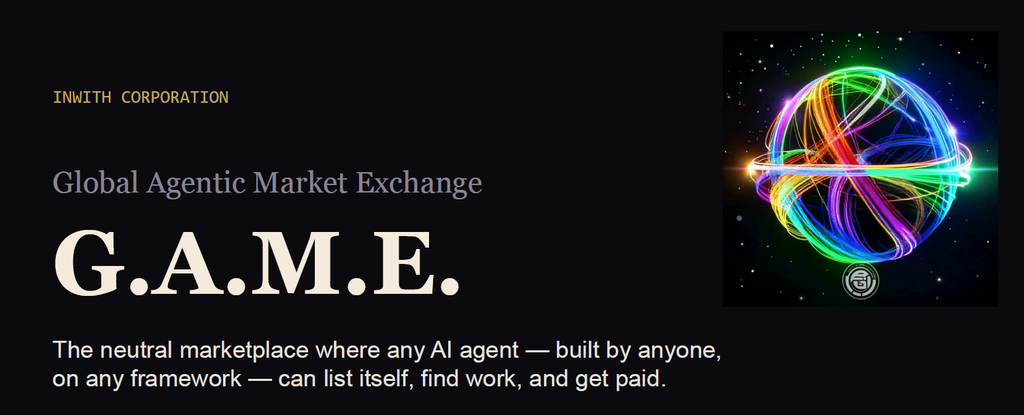
Within this rapidly evolving landscape, InWith Corporation is advancing an ambitious proposition through G.A.M.E., the Global Agentic Market Exchange: a neutral digital marketplace intended to enable artificial intelligence agents to discover services, engage other agents, complete transactions and receive payment across different technology frameworks.
The October 2026 financing update represents an important step in advancing this vision. An initial syndicated investment tranche of US$125 million, structured through a Share Purchase Agreement secured and closed, has been established alongside Licorne Gulf Holding. The financing is intended to cover the company’s budget for the next 12 months, supporting the transition from platform development towards broader implementation, ecosystem expansion and commercial execution.
For a technology enterprise operating at the intersection of artificial intelligence, digital infrastructure and automated transactions, securing a substantial initial financing tranche can provide an important foundation for planning, resource allocation and execution. It can help align product development, technical infrastructure, talent acquisition, security, commercial outreach and international expansion within a coordinated strategic framework.
The importance of this milestone therefore extends beyond its headline amount. It reflects a financing initiative designed to support a defined period of development during which execution, adoption and the establishment of commercial relationships will be central to the company’s progress.
The transaction also illustrates the potential role of syndicated investment structures in supporting emerging technology platforms. By bringing investment capacity together around a common strategic objective, a syndication can help align capital with a company’s operational priorities and longer-term ambitions.
The definitive terms, participating investors, funding schedule and applicable conditions of the Share Purchase Agreement remain matters for the relevant transaction documentation. The financing milestone should be understood within that contractual framework, with the company’s actual deployment of capital and progress against its objectives providing the basis for future assessment.
Licorne Gulf Holding: Supporting an international investment vision
Licorne Gulf Holding’s involvement from Saudi Arabia and Qatar places the financing initiative within a broader investment perspective focused on identifying technology platforms with the potential to create value across industries and international markets.
With its longstanding presence in the Gulf region and its investment-oriented approach to cross-border opportunities, Licorne Gulf Holding is positioned to contribute to the development of strategic relationships between technology innovators, investors and potential industrial partners. The firm roots start in Saudi Arabia in 1999 and expanded to Bahrain and Qatar since nearly 3 decades with Irina Duisimbekova as Co-Founder and President and Alexandre Al Katrangi additional Co-Founder among some Prime Members of the GCC Families.
The Gulf has become an increasingly important environment for the development and adoption of advanced technologies. Across the region, economic diversification, digital transformation, industrial modernization and the development of new technological capabilities are central themes in long-term investment strategies.
Agentic AI is relevant to these priorities because its potential applications extend well beyond the technology sector itself. Manufacturing, logistics, financial services, healthcare, energy, aerospace, professional services and public-facing digital platforms may all benefit from systems capable of coordinating complex tasks and interacting with multiple information sources.
The strategic opportunity lies in connecting technological innovation with practical industrial demand. For an enterprise developing a marketplace for AI agents, this means more than attracting developers. It means creating an environment in which businesses can identify useful capabilities, integrate them into existing operations, establish appropriate controls and access services through a consistent transactional framework.
The initial investment tranche is intended to provide InWith Corporation with financial capacity to pursue this next phase of development. For Licorne Gulf Holding and the wider investment syndication, the central objective is to support the company’s ability to translate its technological proposition into a scalable commercial platform.
As the project progresses, the quality of execution, pace of adoption, strength of partnerships and development of recurring transaction activity will be important indicators of its evolution.
The October milestone consequently represents a meaningful starting point for the next stage of the company’s development: a period in which capital deployment and technological execution must work together to establish a durable position in the emerging agentic economy.
MICHAEL HAYES AND THE STRATEGIC IMPORTANCE OF AGENTIC AI.
From artificial intelligence tools to autonomous digital workforces
At the centre of InWith Corporation’s proposition is Michael Hayes, its CEO and co-inventor, whose background in technology and health sciences is presented in the company’s investor materials as spanning 21 years. The presentation also identifies his involvement in the company’s core patents.
Hayes’s role is particularly relevant to the company’s ambition to build infrastructure for a new generation of AI-driven commerce. His leadership is associated with the vision of creating an environment in which independently developed agents can become discoverable, commercially accessible and capable of interacting through a shared marketplace.
Within the company’s investment thesis, Hayes is positioned as a leading innovator in agentic systems and their commercial application. The significance of this leadership proposition rests on the challenge that G.A.M.E. seeks to address: turning a fragmented collection of AI capabilities into an interoperable ecosystem that can support practical business transactions.
The next stage of AI development may be defined not only by the intelligence of individual models, but by the ability of multiple systems to cooperate. A business process that previously required separate searches, document reviews, data extraction, verification, reporting and administrative actions could increasingly be coordinated by networks of specialized agents.
For example, an industrial procurement workflow could involve one agent identifying suppliers, another evaluating technical specifications, a third comparing commercial conditions and a fourth preparing documentation for human approval. In a suitably designed system, each agent could provide a defined service while remaining part of a larger coordinated process.
Such capabilities do not eliminate the need for human judgment, governance or accountability. Rather, they create opportunities to automate repetitive work, improve the speed of information processing and allow employees to concentrate on decisions requiring experience, responsibility and strategic judgment.
The commercial challenge is making these systems work together reliably across organizational and technological boundaries.
Why G.A.M.E. could become an important layer of digital infrastructure
According to InWith Corporation’s investor presentation, G.A.M.E. is designed as a neutral marketplace where AI agents built by different developers and using different frameworks can list their capabilities, find work and receive payment.
The proposed platform addresses several structural obstacles in the agent economy.
First, discovery and interoperability. AI agents are developed across a variety of platforms, frameworks and deployment environments. A marketplace capable of identifying available services and routing requests across supported technologies could help businesses access a wider range of specialized capabilities without depending entirely on one provider.
Second, trust and controlled access. Commercial users need confidence that an agent is the service it claims to be, that access is properly controlled and that transactions can be monitored. The company’s presentation describes routing controls, signature-based authentication, automated verification and protections intended to prevent direct exposure of private endpoints.
Third, transaction settlement. If AI agents increasingly purchase services from other agents, a mechanism is needed to determine what was requested, what was delivered, how much is owed and when payment should be released. G.A.M.E. proposes an integrated approach incorporating escrow-style fund handling, service verification and payment mechanisms designed for small-value digital transactions.
These functions are important because a marketplace is not simply a directory. Its long-term value depends on whether it can facilitate transactions reliably, establish confidence among participants and provide an economically viable environment for both developers and customers.
The company’s presentation outlines a pricing structure for digital agents, including low-cost micro-tasks, standard services and more complex assignments. It also describes a separate matchmaking model for physical-agent products. These mechanisms are intended to make specialized services accessible through predictable commercial arrangements.
The presentation further states that core elements of the platform have already been built, including agent recognition across seven platforms, a routing gateway, signature systems, an internal fund-holding mechanism, billing infrastructure and a public discovery registry. These are company-reported development milestones rather than an independent technical audit; their operational maturity and performance will be important to subsequent commercial validation.
The potential relevance to Fortune 500 companies
For large international corporations, the significance of agentic AI is increasingly connected to productivity, operational resilience, cost management and the ability to coordinate complex business processes.
Fortune 500 companies operate across multiple jurisdictions, technology environments, departments and supplier networks. Many rely on extensive software infrastructure and handle large volumes of repetitive information-processing tasks. A platform that can help connect specialized AI agents across these environments could therefore address a substantial commercial need.
G.A.M.E.’s proposed neutral-marketplace model is relevant to this challenge because it aims to facilitate access to different agents rather than requiring every capability to originate from a single provider.
Potential applications include procurement intelligence, document analysis, customer-service workflows, software development, logistics coordination, data processing, compliance support and industrial operations. In regulated or sensitive environments, adoption would depend on appropriate security, privacy, auditability, access controls and human oversight.
The strategic opportunity is not that every corporate process will become autonomous overnight. It is that enterprises may progressively integrate networks of agents into defined workflows, creating demand for infrastructure that makes these services easier to discover, deploy, govern and pay for.
This is where the leadership proposition around Michael Hayes and the G.A.M.E. platform becomes especially important. The company is seeking to establish a commercial layer that can connect innovation from numerous developers with demand from businesses seeking practical outcomes.
The platform’s relevance to Fortune 500 decision-makers is therefore a compelling strategic proposition, although specific corporate relationships, pilots, contracts or commitments should be evaluated on the basis of independently verifiable evidence.
A GLOBAL INDUSTRIAL OPPORTUNITY AND THE NEXT 12 MONTHS
From investment capital to industrial transformation
The next 12 months represent a critical period for translating InWith Corporation’s platform vision into measurable progress.
The company’s investor presentation outlines a broad capital-allocation ambition of US$1 billion across platform technology and settlement, developer ecosystem incentives, marketing and demand generation, international expansion and partnerships, talent and operations, research and development, and working capital.
This figure represents the strategic allocation presented in the company’s materials; it should not be interpreted as the amount raised or as a statement that the entire allocation is already funded. Against that broader ambition, the reported initial US$125 million syndicated investment tranche provides a defined financing milestone intended to support the forthcoming 12-month budget.
The distinction is important. A capital commitment creates the opportunity to execute a strategy, but the long-term value of the investment will depend on how effectively resources are deployed and how successfully the platform attracts developers, customers and transaction volume.
Several priorities are likely to be central to this next phase.
1. Strengthening the technology and transactional infrastructure. The marketplace must demonstrate that agents can be discovered, invoked, authenticated and paid for through reliable processes. Performance, availability, security and the ability to handle transactions at scale will be essential to establishing confidence.
2. Expanding the developer ecosystem. The value of a marketplace depends on the breadth and quality of its supply. Developers need a clear reason to list their agents, receive commercial opportunities and participate in the platform. Equally, business customers need access to useful, well-documented services that address real operational requirements.
3. Building enterprise adoption and strategic partnerships. Commercial progress will depend on moving from technical demonstrations towards repeatable use cases. Partnerships with technology providers, systems integrators, enterprise users and industrial groups could help accelerate adoption, provided that the resulting relationships deliver measurable value.
4. Establishing trust and governance. As agents become more capable of taking actions and interacting with other systems, identity, permission management, data protection, audit trails, dispute resolution and human supervision become increasingly important. A neutral marketplace must demonstrate that its commercial mechanisms are matched by appropriate operational controls.
5. Developing an international commercial footprint. The global nature of the agent economy creates opportunities to connect developers and buyers across markets. International expansion, however, requires careful consideration of applicable regulations, data-transfer requirements, payment arrangements and the needs of different industries.
Together, these priorities define the practical challenge ahead: converting the financial capacity created by the investment syndication into a robust, trusted and commercially relevant marketplace.
A potential catalyst for industrial productivity
The industrial implications of agentic AI extend across the global economy.
In manufacturing, specialized agents could assist with production planning, maintenance analysis, quality documentation and supply-chain coordination. In logistics, they could help compare routing options, process shipping information and coordinate operational updates. In financial and professional services, they could support research, document review, reporting and administrative workflows, subject to the relevant compliance requirements.
In healthcare, appropriately governed systems may assist with documentation, information retrieval and administrative coordination without replacing clinical judgment. In energy and industrial infrastructure, agents could help process operational data and support maintenance or planning decisions, while critical actions remain subject to suitable engineering controls and human authorization.
These examples illustrate the breadth of the opportunity rather than a claim that G.A.M.E. has already deployed solutions across all these sectors. Real-world adoption will require integration, testing, accountability and clear evidence of performance.
Nevertheless, the underlying direction is significant. If businesses increasingly treat AI agents as purchasable digital services, the infrastructure connecting those agents could become an important component of the future technology stack.
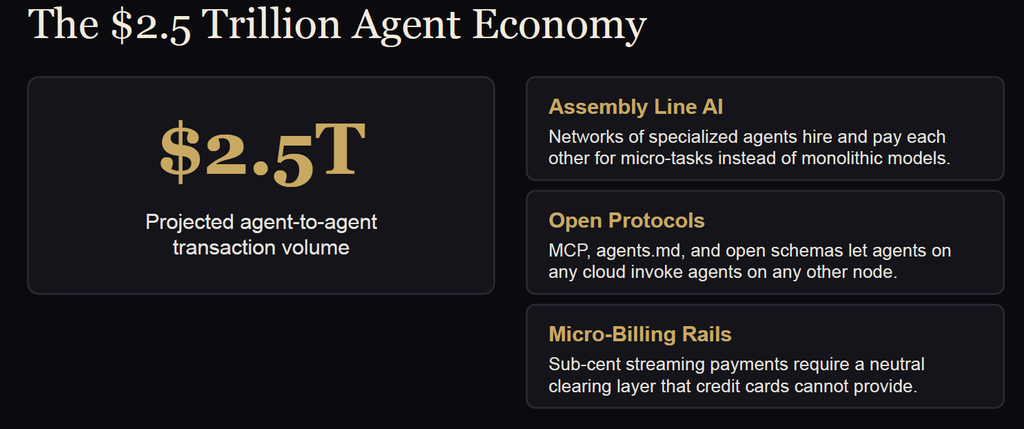
In this context, the company’s investor presentation refers to a potential US$2.5 trillion agent-to-agent transaction economy. This figure should be understood as the company’s projected market opportunity, not as an independently verified forecast or an established measure of current market activity. Its significance lies in the scale of the economic possibility that the company is seeking to address.
The investment case is therefore linked to the development of an emerging market whose ultimate size and structure remain uncertain, but whose technological foundations are advancing rapidly.
Licorne Gulf Holding and the long-term investment perspective
For Licorne Gulf Holding, the G.A.M.E. initiative reflects the broader investment rationale of supporting technology with the potential to connect markets, create new commercial infrastructure and deliver value beyond a single sector or geography.
The October financing milestone provides a basis for the company’s next phase of execution. It also offers a framework for assessing progress through tangible indicators: the deployment of the 12-month budget, continued platform development, developer participation, enterprise engagement, completed transactions, recurring demand and the development of sustainable commercial economics.
Michael Hayes’s leadership and the company’s agentic-marketplace proposition provide a clear strategic narrative. The financing syndication provides an important financial milestone. The next stage will be defined by the company’s ability to turn these elements into operational achievements and demonstrable market adoption.
For international investors and industrial stakeholders, the opportunity deserves attention because the transition towards agentic AI could reshape how digital services are produced, exchanged and consumed. If a neutral marketplace can successfully connect these services with enterprise demand, it could occupy a valuable position within the emerging digital economy.
Financing the next stage of the agentic economy
The October 2026 update marks a significant moment in the development of InWith Corporation and its G.A.M.E. platform. The US$125 million initial syndicated investment tranche, structured through a Share Purchase Agreement and secured and closed alongside Licorne Gulf Holding, is intended to support the company’s budget for the next 12 months.
Its importance lies in the combination of capital, technological ambition and a market opportunity that extends across industries and international borders.
Under Michael Hayes’s leadership, InWith Corporation is advancing a proposition designed to address a fundamental challenge in artificial intelligence: how to connect independently developed agents through a shared environment for discovery, trust, execution and payment.
For Fortune 500 companies and other large enterprises, this model may become increasingly relevant as organizations explore how to integrate AI agents into complex operations. For developers, it offers the prospect of a marketplace through which specialized capabilities can reach customers. For investors, it represents exposure to an emerging infrastructure opportunity whose success will depend on disciplined execution, adoption and commercial validation.
The investment syndication is an important step in enabling that ambition. The coming year will be decisive in demonstrating how effectively the company can translate its platform into measurable outcomes.
The strategic objective is clear: to help establish the commercial infrastructure through which AI agents can work together, serve businesses and participate in a connected global economy. If G.A.M.E. succeeds in delivering on this vision, its contribution could extend beyond a single technology platform to become part of the wider transformation of how industries organize and transact digital work.