Dried potato flakes are quietly becoming a staple ingredient in kitchens and food production lines alike, and new data from The Business Research Company suggests this unassuming product is on a steady upward climb. With consumer habits shifting toward convenience and shelf-stable foods, the market’s projected growth signals bigger changes ahead for the processed food industry.
The Business Research Company’s Recent Dried Potato Flakes Global Market Report 2026 – Market Size, Trends, And Forecast 2026-2035
The dried potato flakes market has posted significant gains in recent years, propelled by evolving consumer preferences and the ongoing expansion of the processed food sector. With convenience and extended shelf life becoming increasingly prized attributes, industry observers expect this momentum to carry forward. Here is a closer look at where the market stands today, what is driving its growth, and which regions are leading the charge.
Market Size and Growth Forecast
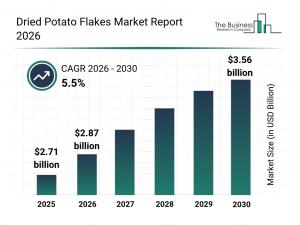
The dried potato flakes market has grown steadily over the past several years, and projections indicate that trajectory will continue. According to the report, the market is expected to climb from $2.71 billion in 2025 to $2.87 billion in 2026, representing a compound annual growth rate (CAGR) of 5.9%. That expansion is attributed to rising consumption of convenience foods, a growing processed food industry, heightened demand for long-life ingredients, widespread adoption of instant meal products, and increased use of potato-based components in bakery and snack applications.
Looking further ahead, the market is forecast to reach $3.56 billion by 2030, with a slightly moderated CAGR of 5.5%. Drivers expected to sustain growth during that period include growing demand for ready-to-cook foods, preference for versatile ingredients, wider adoption of premium potato flake varieties, expanding needs from foodservice and retail channels, and a stronger focus on effective food preservation methods. Emerging trends likely to shape the market include rising interest in dehydrated potato convenience products, stronger demand for clean-label and natural ingredients, broader integration of processed potato components in food formulations, heightened attention to extended shelf life, and a growing market for customized potato flakes designed for industrial use.
Download a free sample of the dried potato flakes market report:
https://www.thebusinessresearchcompany.com/sample_request?id=54653884&type=smp&name=Dried%20Potato%20Flakes%20Market%20Report%202026&utm_source=EINPresswire&utm_medium=Paid&utm_campaign=Oct_PR
What Are Dried Potato Flakes and How Are They Used?
Dried potato flakes are produced by cooking, mashing, and drying fresh potatoes into thin, flaky pieces that can be quickly rehydrated with water or milk. Their ease of use, long shelf life, and consistent quality make them a versatile ingredient across a wide range of food products, including instant mashed potatoes, bakery items, snacks, soups, and other processed formulations. For manufacturers and home cooks alike, these flakes offer a dependable and convenient ingredient option.
How Ready-to-Eat and Convenience Food Trends Are Driving Growth
The surging popularity of ready-to-eat (RTE) and convenience food products is one of the key forces behind the dried potato flakes market’s expansion. These pre-prepared or easy-to-assemble foods are designed to minimize the time and effort required for meal preparation, aligning with increasingly busy lifestyles that favor quick and simple solutions.
Dried potato flakes fit naturally into this picture, giving manufacturers a fast, flexible, and shelf-stable ingredient that streamlines production of instant mashed potatoes, snacks, and other processed foods. For example, in October 2024, the US Department of Agriculture’s Economic Research Service reported that spending on food away from home rose by 12.0% to $4,485 per capita in 2023, up from $4,004 in 2022. Additionally, the share of disposable personal income allocated to eating out increased to 5.9% in 2023 from 5.6% the prior year. Those figures underscore the growing consumer reliance on convenient food options, which in turn supports demand for dried potato flakes.
View the full dried potato flakes market report:
https://www.thebusinessresearchcompany.com/report/dried-potato-flakes-market-report?utm_source=EINPresswire&utm_medium=Paid&utm_campaign=Oct_PR
Regional Leadership and Growth Outlook
In 2025, North America held the largest share of the dried potato flakes market, maintaining a leading position on the global stage. However, the Asia-Pacific region is expected to be the fastest-growing market over the forecast period, reflecting rising consumption, increased industrialization, and shifting dietary preferences in that part of the world. The report covers a broad range of geographic regions, including Asia-Pacific, South East Asia, Western Europe, Eastern Europe, North America, South America, the Middle East, and Africa, offering a comprehensive view of global market dynamics.
The 2026 market reports from The Business Research Company now include expanded strategic coverage through market attractiveness scoring and analysis, total addressable market (TAM) analysis, company scoring matrix graphics and tables, Excel-based forecasting dashboards, market hotspots infographics, key technologies and future trend analysis, along with updated graphics and tables.
Speak With Our Expert:
Saumya Sahay
Americas +1 310-496-7795
Asia +44 7882 955267 & +91 8897263534
Europe +44 7882 955267
Email: marketing@tbrc.info
The Business Research Company – www.thebusinessresearchcompany.com
Follow Us On:
• LinkedIn: https://in.linkedin.com/company/the-business-research-company
Oliver Guirdham
The Business Research Company
+44 7882 955267
info@tbrc.info
Visit us on social media:
LinkedIn
Facebook
X
Why it matters: As consumer habits continue to shift toward convenience foods and shelf-stable ingredients, the dried potato flakes market’s steady growth reflects broader changes in how people eat and cook. For food manufacturers, retailers, and investors, understanding this trajectory offers insight into where processed food demand is heading — and which regions will drive that growth in the years ahead.