
The numbers behind industrial security are getting harder to ignore: a market projected to climb from $42.93 billion to nearly $63 billion within five years, driven by a surge in cyber and physical threats targeting critical infrastructure. The Business Research Company’s latest analysis lays out the trajectory, and the implications for businesses are significant.
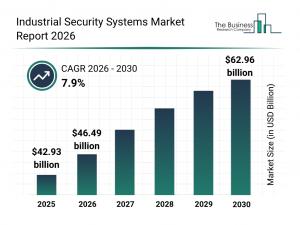
The Business Research Company’s Industrial Security Systems Global Market Report 2026 – Market Size, Trends, And Forecast 2026-2035
According to the newly released industrial security systems market report, the sector is gaining notable momentum as industries worldwide seek stronger protection mechanisms. With mounting security challenges and rapidly evolving technology, this space is primed for considerable expansion. The report examines market size projections, growth drivers, regional patterns, and the key innovations likely to shape the future of industrial security.
Market size and growth outlook
The industrial security systems market has already seen meaningful expansion in recent years. Projections show it climbing from $42.93 billion in 2025 to $46.49 billion in 2026, representing a compound annual growth rate (CAGR) of 8.3%. That historic growth stems largely from intensifying security threats at industrial sites, stricter regulatory and safety requirements, increased demand for critical infrastructure protection, and a greater emphasis on workforce safety and controlled facility access.
Download a free sample of the industrial security systems market report:
https://www.thebusinessresearchcompany.com/sample_request?id=19651043&type=smp&name=Industrial%20Security%20Systems%20Market%20Report%202026&utm_source=EINPresswire&utm_medium=Paid&utm_campaign=Oct_PR
Beyond the near term, the market is expected to keep climbing, reaching $62.96 billion by 2030 with a steady CAGR of 7.9%. That anticipated rise is tied to several forces: the convergence of physical and cybersecurity measures, growing demand for real-time monitoring, wider adoption of automated threat detection, and a push toward integrated emergency response frameworks. Notable trends in this period include biometric access controls, advanced intrusion detection systems, centralized security command centers, and comprehensive incident management platforms.
What exactly counts as an industrial security system? These are integrated technologies designed to protect industrial sites, critical assets, personnel, and infrastructure from both physical and cyber threats. The toolkit spans surveillance equipment, access control mechanisms, intrusion detection, fire and safety monitoring, and cybersecurity defenses. When combined, these elements help reduce risk, support operational continuity, and enable compliance with relevant industry standards.
View the full industrial security systems market report:
https://www.thebusinessresearchcompany.com/report/industrial-security-systems-market-report?utm_source=EINPresswire&utm_medium=Paid&utm_campaign=Oct_PR
One of the strongest tailwinds for this market is the rise in security threats aimed at industrial environments. These range from physical breaches to cyber attacks designed to disrupt operations, inflict financial losses, or endanger safety. As industrial and critical infrastructure becomes more interconnected, vulnerabilities multiply — exposing organizations to greater risks of unauthorized access and digital intrusions.
Industrial security systems respond to these pressures by enabling continuous surveillance, rapid threat identification, and coordinated emergency responses that protect essential infrastructure, assets, and workers. A concrete example: in November 2024, the Australian Signals Directorate logged more than 36,700 calls to its Australian Cyber Security Hotline during the 2023–24 fiscal year — a 12% jump from the prior year. Of the cyber incidents handled, over 11% were tied to critical infrastructure, highlighting the urgent need for stronger security tools and helping drive market growth.
Geographically, North America held the largest share of the industrial security systems market in 2025, thanks to advanced infrastructure and broad adoption of security technologies. The Asia-Pacific region, however, is projected to be the fastest-growing market over the forecast period. The report spans all major regions — including Asia-Pacific, South East Asia, Western and Eastern Europe, North and South America, the Middle East, and Africa — offering a comprehensive view of global market dynamics.
The 2026 reports also feature expanded strategic and visual intelligence, including market attractiveness scoring, total addressable market (TAM) analysis, company scoring matrices with graphics and tables, Excel-based forecasting dashboards, market hotspot infographics, and analysis of key technologies and future trends, alongside updated graphics and tables.
Speak With Our Expert:
Saumya Sahay
Americas +1 310-496-7795
Asia +44 7882 955267 & +91 8897263534
Europe +44 7882 955267
Email: marketing@tbrc.info
The Business Research Company – www.thebusinessresearchcompany.com
Follow Us On:
• LinkedIn: https://in.linkedin.com/company/the-business-research-company
Oliver Guirdham
The Business Research Company
+44 7882 955267
info@tbrc.info
Visit us on social media:
LinkedIn
Facebook
X
Why it matters: As industrial infrastructure becomes a bigger target for both physical and digital threats, the tools designed to protect it are evolving into a major growth sector. Businesses that track these trends early can make more informed decisions about security investments, compliance readiness, and operational resilience in an increasingly volatile landscape.