The Business Research Company’s latest forecast offers a revealing look at where smart materials are headed: the functional polymers sector is not just growing—it’s being reshaped by electric vehicles and precision medicine. Here’s what the data shows about this $10 billion-plus market.

The Business Research Company’s Functional Polymers Market Global Market Report 2026 – Market Size, Trends, And Forecast 2026-2035
Demand for functional polymers continues to accelerate across multiple industries, fueled by technological breakthroughs and widening real-world applications. The sector is tracking a steady expansion, and the numbers tell a story of sustained momentum. Below, we break down how market size has shifted, what’s driving growth, which segments matter most, where regional hotspots are emerging, and which companies are setting the pace.
Also worth a look: Villa La Personala turns a historic estate into a luxury gateway to Italy’s Motor Valley and Food Valley and Chemical tanker coatings market set to hit $4.01B by 2030 as fleet expands.
Recent Growth and Projected Expansion of the Functional Polymers Market
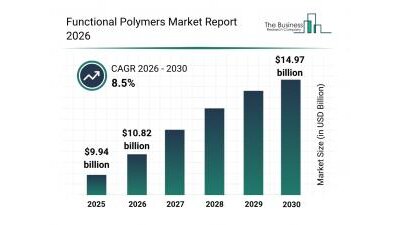
Over recent years, the functional polymers market has experienced robust growth. It is expected to increase from $9.94 billion in 2025 to $10.82 billion in 2026, representing a compound annual growth rate (CAGR) of 8.9%. This surge is largely attributed to the rising demand for specialty polymers, expanding applications in electronics and electrical fields, increased use in healthcare and pharmaceuticals, greater water treatment activities, and a growing need for high-performance automotive materials. Looking ahead, the market is forecast to reach $14.97 billion by 2030, growing at a CAGR of 8.5%. This future growth is driven by the rising adoption of smart and responsive polymers, advanced drug delivery technologies, high-performance membranes, expanded aerospace and defense applications, and a stronger focus on environmentally sustainable polymer solutions. Key trends expected to influence the market include development of conductive polymers, ion-exchange materials, self-healing and shape-memory polymers, multifunctional formulations, and innovative surface modification techniques.
Download a free sample of the functional polymers market report:
https://www.thebusinessresearchcompany.com/sample_request?id=82983301&type=smp&name=Functional%20Polymers%20Market%20Report%202026&utm_source=EINPresswire&utm_medium=Paid&utm_campaign=Nov_PR
The Rising Impact of Electric Vehicles on Functional Polymers Market Growth
One of the primary drivers behind the functional polymers market is the increasing adoption of electric vehicles (EVs). These vehicles rely on electric power systems including rechargeable batteries, motors, and control units. Government incentives and stricter emission regulations are accelerating the shift toward cleaner transportation options, encouraging greater EV use. This trend is boosting demand for functional polymers that provide essential properties such as electrical insulation, thermal protection, lightweight construction, impact resistance, sealing, and vibration control in components like battery housings and power electronics. For instance, in January 2026, the Electric Vehicle Council reported that Australia’s EV sales rose by 38% in 2025 compared to the previous year, with EVs accounting for 13.1% of new car sales, up from 9.6% in 2024. Such growth directly supports the rising need for advanced polymer materials within the functional polymers market.
Key Segments Contributing to Functional Polymers Market Growth
This report divides the functional polymers market into several important segments:
1) Functional Polymer Types: including Conductive Polymers, Ion Exchange Polymers, Stimuli-Responsive Polymers, Self-Healing Polymers, Shape Memory Polymers, Superabsorbent Polymers, Functionalized Polyolefins, Biofunctional Polymers, Flame-Retardant Polymers, and Photoresponsive Polymers.
2) Functional Properties: such as Electrical and Ionic Conductivity, Ion Exchange, Stimuli Responsiveness, Self-Healing, Shape Memory, Superabsorbency, Biocompatibility, Flame Retardancy, and Optical Responsiveness.
3) Forms: comprising Pellets and Granules, Powders, Films and Sheets, Fibers, Liquid Resins, Coatings, and Dispersions.
4) End-User Industries: covering Automotive, Electronics and Electrical, Healthcare and Pharmaceuticals, Packaging, Construction, Water Treatment and Environmental, Aerospace and Defense sectors.
View the full functional polymers market report:
https://www.thebusinessresearchcompany.com/report/functional-polymers-market-report?utm_source=EINPresswire&utm_medium=Paid&utm_campaign=Nov_PR
Within these, further detailed subcategories include specific polymer types such as polyaniline and polypyrrole under conductive polymers, cation and anion exchange polymers, various stimuli-responsive types, self-healing polymer networks, and different kinds of shape memory polymers. Other subsegments focus on superabsorbents like sodium polyacrylate, varieties of functionalized polyolefins, biodegradable biofunctional polymers, halogenated and phosphorus-containing flame retardants, and diverse photoresponsive polymers.
Innovations and Emerging Trends Driving Functional Polymers Industry Forward
Market leaders are increasingly focusing on advanced polymer technologies to meet evolving industry demands. A notable example is the development of pH-responsive polymer capsules designed for targeted drug delivery. These capsules maintain integrity in the acidic stomach environment but release their contents in the intestine, enabling precise delivery of sensitive pharmaceuticals. In October 2025, Evonik Industries AG introduced EUDRACAP colon functional capsules, featuring good manufacturing practice quality for clinical and commercial use. This innovation facilitates the safe oral delivery of fragile active ingredients including live biotherapeutics, RNA, and biologics, while streamlining formulation processes and accelerating pharmaceutical development timelines. Such advancements highlight the potential of functional polymers to revolutionize drug delivery and other specialized applications.
Global Regional Trends Shaping Functional Polymers Market Development
In 2025, North America held the largest share of the functional polymers market. However, the Asia-Pacific region is projected to exhibit the fastest growth throughout the forecast period. The market coverage also includes South East Asia, Western and Eastern Europe, South America, the Middle East, and Africa, providing a comprehensive global perspective on regional dynamics and opportunities.
Leading Companies Driving the Functional Polymers Market
Several prominent corporations are at the forefront of innovation and production in the functional polymers industry. Key players include BASF SE, Dow Inc., SABIC, LyondellBasell Industries N.V., Mitsubishi Chemical Group Corporation, DuPont de Nemours Inc., Syensqo SA, Asahi Kasei Corporation, Sumitomo Chemical Co. Ltd., Toray Industries Inc., LG Chem Ltd., Evonik Industries AG, Celanese Corporation, Arkema S.A., Shin-Etsu Chemical Co. Ltd., 3M Company, Eastman Chemical Company, Henkel AG & Co. KGaA, Wacker Chemie AG, LANXESS AG, Huntsman Corporation, Kuraray Co. Ltd., SEKISUI CHEMICAL CO. LTD., Avient Corporation, and Tosoh Corporation. These companies are continually pushing boundaries with new materials and solutions that enable the functional polymers market to meet growing industrial demands.
Our 2026 market reports now feature expanded strategic intelligence through market attractiveness scoring and analysis, total addressable market (TAM) analysis, company scoring matrix graphics and tables, Excel-based dashboards, market hotspots infographics, key technology and future trend analysis, along with updated graphics and tables.
Speak With Our Expert:
Saumya Sahay
Americas +1 310-496-7795
Asia +44 7882 955267 & +91 8897263534
Europe +44 7882 955267
Email: marketing@tbrc.info
The Business Research Company – www.thebusinessresearchcompany.com
Follow Us On:
• LinkedIn: https://in.linkedin.com/company/the-business-research-company
Oliver Guirdham
The Business Research Company
+44 7882 955267
info@tbrc.info
Visit us on social media:
LinkedIn
Facebook
X
Why it matters: Functional polymers are the invisible backbone of the electric vehicle revolution and next-generation medicine, from battery housings to pH-responsive drug capsules. As industries race toward sustainability and precision, the $14.97 billion forecast by 2030 signals that these materials will be critical to technological progress across automotive, healthcare, and electronics sectors worldwide.