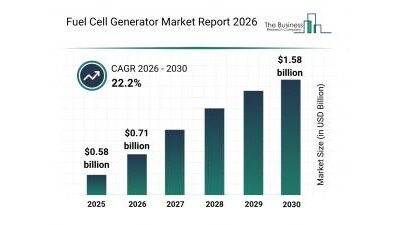
The numbers coming out of a new market analysis from The Business Research Company suggest that fuel cell generators are no longer a niche technology — they are becoming a cornerstone of the global clean energy transition. With a projected compound annual growth rate of 22.2% through 2030, the industry is poised for explosive growth, driven by everything from hydrogen infrastructure build-out to the rising need for off-grid and backup power solutions.

The Business Research Company’s Fuel Cell Generator Global Market Report 2026 – Market Size, Trends, And Forecast 2026-2035 lays out the trajectory in detail.
The fuel cell generator market has already shown impressive momentum. Valued at $0.58 billion in 2025, it is expected to climb to $0.71 billion in 2026 — a compound annual growth rate of 22.6%. That surge, the report notes, reflects a growing dependence on reliable backup power, the spread of distributed generation systems, a shift toward cleaner electricity, wider use of natural gas-based fuel cell technologies, and more installations in commercial facilities.
Also worth a look: Villa La Personala turns a historic estate into a luxury gateway to Italy’s Motor Valley and Food Valley and Chemical tanker coatings market set to hit $4.01B by 2030 as fleet expands.
Download a free sample of the fuel cell generator market report:
https://www.thebusinessresearchcompany.com/sample_request?id=63246342&type=smp&name=Fuel%20Cell%20Generator%20Market%20Report%202026&utm_source=EINPresswire&utm_medium=Paid&utm_campaign=Nov_PR
Looking further ahead, the market is forecast to reach $1.58 billion by 2030, maintaining a CAGR of 22.2%. The drivers are clear: expanding hydrogen production and distribution networks, growing appetite for resilient off-grid power, rising investment in clean energy infrastructure, wider adoption of combined heat and power (CHP) systems, and a broader shift toward decentralized power generation. Among the key trends shaping this period are increased use of hydrogen fuel cell generators, more efficient fuel cell designs, the rise of modular units, hybrid fuel cell configurations, and a push for compact, lightweight generators.
The push for clean, low-emission electricity is one of the most powerful forces behind this growth. Governments and industries worldwide are embracing renewable and low-carbon options to reduce greenhouse gas emissions and combat climate change. Fuel cell generators, which deliver efficient and environmentally friendly electricity for stationary, backup, and distributed power applications, are increasingly seen as a key part of that solution.
View the full fuel cell generator market report:
https://www.thebusinessresearchcompany.com/report/fuel-cell-generator-market-report?utm_source=EINPresswire&utm_medium=Paid&utm_campaign=Nov_PR
To put this in context, consider the broader clean energy landscape. According to the Environmental Defense Fund’s State of Clean Power report for the first quarter of 2026, the United States had 471.1 gigawatts of operational clean power capacity in early 2026, following a record addition of 51.6 GW in 2025. That expanding clean energy base creates a natural market for fuel cell generators, which align directly with the world’s growing clean power requirements.
The market is segmented across several dimensions to capture its full complexity:
By Type:
– Proton Exchange Membrane (PEM) Fuel Cell Generators
– Solid Oxide Fuel Cell Generators
– Phosphoric Acid Fuel Cell Generators
– Molten Carbonate Fuel Cell Generators
– Alkaline Fuel Cell Generators
By Fuel Source:
– Hydrogen
– Natural Gas
– Methanol
– Biogas
By Distribution Channel:
– Online Channels
– Direct Sales
– Distributors and Dealers
By Application Area:
– Prime Power
– Backup Power
– Combined Heat and Power (CHP)
– Off-Grid Power
By End Use Sector:
– Residential
– Commercial
– Industrial
Each generator type is further broken down into subcategories — low- and high-temperature PEM generators, planar and tubular solid oxide units, stationary and portable phosphoric acid systems, internal and external reforming molten carbonate generators, and mobile and stationary alkaline fuel cell generators.
Innovation is accelerating across the board. Leading companies are pushing hydrogen-powered fuel cell generator systems to deliver cleaner output, lower carbon emissions, and more dependable distributed energy. These systems convert hydrogen into electricity through electrochemical reactions, producing power without combustion.
A standout example: Toyota Industries Corporation introduced an 8 kW hydrogen fuel cell module in November 2025, designed for both stationary and portable generators. By combining the fuel cell stack, air compressor, and hydrogen circulation pump into one compact unit, the module improves efficiency while reducing size and development time. Innovations like this are critical to speeding up adoption of hydrogen-based clean power technologies.
Geographically, North America held the largest market share in 2025. But the Asia-Pacific region is expected to post the fastest growth over the forecast period. The analysis covers Asia-Pacific, South East Asia, Western Europe, Eastern Europe, North America, South America, the Middle East, and Africa, offering a global view of trends and opportunities.
Major players driving the industry include Mitsubishi Heavy Industries Ltd, Toshiba Corporation, Panasonic Holdings Corporation, Robert Bosch GmbH, Cummins Inc, Kyocera Corporation, Aisin Corporation, Bloom Energy Corporation, Plug Power Inc, TECO Electric & Machinery Co Ltd, Doosan Fuel Cell Co Ltd, Ballard Power Systems Inc, FuelCell Energy Inc, Ceres Power Holdings plc, PowerCell Sweden AB, SFC Energy AG, Intelligent Energy Limited, Elcogen AS, Sunrise Power Co Ltd, Alstom SA, Nedstack Fuel Cell Technology BV, Proton Motor Fuel Cell GmbH, GenCell Ltd, and Advent Technologies Holdings Inc. These companies are central to advancing technology and expanding market reach across applications.
New additions to the 2026 reports include:
• Market attractiveness scoring and analysis
• Total addressable market (TAM) analysis
• Company scoring matrix graphics and tables
• Excel-based forecasting dashboards
• Market hotspots infographics
• Key technologies and future trend analysis
• Updated graphics and tables
Speak With Our Expert:
Saumya Sahay
Americas +1 310-496-7795
Asia +44 7882 955267 & +91 8897263534
Europe +44 7882 955267
Email: marketing@tbrc.info
The Business Research Company – www.thebusinessresearchcompany.com
Follow Us On:
• LinkedIn: https://in.linkedin.com/company/the-business-research-company
Oliver Guirdham
The Business Research Company
+44 7882 955267
info@tbrc.info
Visit us on social media:
LinkedIn
Facebook
X
Why it matters: As global clean power capacity expands — with the U.S. alone adding a record 51.6 GW in 2025 — fuel cell generators are emerging as a critical technology for reliable, low-emission energy. The projected near-tripling of this market by 2030 signals that hydrogen and fuel cell systems are moving from pilot projects into mainstream commercial reality, reshaping how businesses and communities think about backup and distributed power.