The numbers coming out of the latest industry forecast for crossover vehicles are hard to ignore: a market projected to nearly double in size within a decade. Car buyers increasingly want the versatility of an SUV with the fuel economy of a sedan, and automakers are racing to deliver exactly that.
The Business Research Company's Crossover Vehicles Market Report 2026 – Market Size, Trends, And Global Forecast 2026-2035
According to The Business Research Company, the crossover vehicles market has already posted impressive gains, driven by a fundamental shift in what consumers expect from their daily drivers. Urbanization, the desire for fuel-efficient yet roomy vehicles, and better roads are all feeding demand for models that blend car-like handling with SUV-style utility. The report breaks down exactly how big this segment has become and where it is heading.
Also worth a look: Villa La Personala turns a historic estate into a luxury gateway to Italy’s Motor Valley and Food Valley and Chemical tanker coatings market set to hit $4.01B by 2030 as fleet expands.
Recent Growth and Projected Expansion of the Crossover Vehicles Market
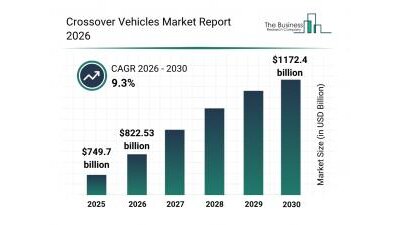
The sector has been on a steep climb. From $749.7 billion in 2025, the market jumped to $822.53 billion in 2026, a compound annual growth rate (CAGR) of 9.7%. That momentum came from rapid urbanization, rising vehicle ownership in cities, a strong consumer tilt toward SUV-inspired designs, greater appetite for fuel-efficient passenger cars, better road networks, and higher household incomes across many regions.
Download a free sample of the crossover vehicles market report:
https://www.thebusinessresearchcompany.com/sample_request?id=14913898&type=smp&name=Crossover%20Vehicles%20Market%20Report%202026&utm_source=EINPresswire&utm_medium=Paid&utm_campaign=Nov_PR
Looking further out, the market is expected to reach $1172.4 billion by 2030, growing at a CAGR of 9.3%. Analysts point to sustained demand for affordable family transportation, a preference for versatile passenger vehicles, and rising expectations around ride comfort and handling as key drivers. Automakers are also expanding their crossover lineups, pushing into emerging markets, and introducing compact and subcompact models. Features like elevated seating, flexible cargo configurations, all-wheel-drive options, and growing commercial and fleet adoption are all expected to fuel the next wave of growth.
Rising Demand for Fuel-Efficient Vehicles Boosting the Crossover Market
A central force behind the crossover boom is the consumer push for fuel-efficient automobiles. These vehicles use advanced powertrains, lightweight materials, and smarter energy management to consume less fuel per mile. With fuel prices and commuting costs climbing, economy at the pump has become a make-or-break factor for many buyers.
View the full crossover vehicles market report:
https://www.thebusinessresearchcompany.com/report/crossover-vehicles-market-report?utm_source=EINPresswire&utm_medium=Paid&utm_campaign=Nov_PR
This trend directly supports the shift toward compact and lightweight crossover models that deliver practicality without sacrificing comfort. The United States Energy Information Administration reported that vehicle miles traveled rose 1.2% in 2025 compared to 2024, while fleet fuel economy improved 1.9% during the same period. Those figures underscore how fuel efficiency is becoming more critical as Americans drive more, and crossovers are positioned to capture that demand.
Core Segments Driving the Expansion of the Crossover Vehicles Industry
The market splits into several distinct categories that each contribute to its growth trajectory:
1) Vehicle Size: Subcompact, Compact, Midsize, and Full-Size Crossovers
2) Drive Type: Front-Wheel Drive, Rear-Wheel Drive, All-Wheel Drive, Four-Wheel Drive
3) Propulsion Type: Petrol, Diesel, Hybrid, Electric
4) Sales Channel: Authorized Dealers, Independent Dealers, Online Sales Platforms
5) Application: Personal Use and Commercial or Fleet Use
Within the vehicle size categories, further subsegments exist for gasoline, diesel, hybrid, plug-in hybrid, and battery electric variants. This granular segmentation allows manufacturers to tailor their products to specific consumer preferences and tightening regulatory standards around the world.
Technological Innovations Shaping the Future of the Crossover Vehicles Market
Major automakers are pouring resources into next-generation technology, with extended-range electric vehicles (EREVs) emerging as a key focus. EREV systems use electric motors to drive the wheels while a small internal combustion engine acts solely as a generator to recharge the battery, extending the driving range without directly powering the vehicle.
A concrete example arrived in July 2026, when Xiaomi Corporation launched its Sky Nomad SUV series. The lineup includes five- and seven-seat models with intelligent driving systems, connected vehicle technologies, and an extended-range electric powertrain. The cabin design emphasizes multifunctionality and everyday comfort, representing a clear direction for crossover innovation.
Key Regional Markets and Emerging Opportunities in Crossover Vehicles
North America held the largest regional market share for crossover vehicles in 2025. But the Asia-Pacific region is expected to lead growth over the forecast period, fueled by expanding urban populations and rising disposable incomes. The report covers Asia-Pacific, South East Asia, Western Europe, Eastern Europe, North America, South America, the Middle East, and Africa, providing a global view of market trends and opportunities.
Prominent Companies Leading the Crossover Vehicles Industry
A long roster of major manufacturers dominates the crossover segment. These include Toyota Motor Corporation, Volkswagen AG, Hyundai Motor Company, General Motors Company, Ford Motor Company, Stellantis N.V., Tesla Inc., Honda Motor Co. Ltd., Nissan Motor Co. Ltd., BYD Company Limited, Mercedes-Benz Group AG, Bayerische Motoren Werke AG, Renault S.A., Geely Automobile Holdings Limited, Tata Motors Limited, Great Wall Motor Company Limited, Changan Automobile Co. Ltd., Chery Automobile Co. Ltd., Mahindra & Mahindra Limited, Mazda Motor Corporation, Subaru Corporation, Suzuki Motor Corporation, Mitsubishi Motors Corporation, and Kia Corporation. Their broad portfolios and continuous innovation keep pushing the sector forward.
Our 2026 market reports now feature expanded strategic intelligence through market attractiveness scoring and analysis, total addressable market (TAM) analysis, company scoring matrix graphics and tables, Excel-based dashboards, market hotspots infographics, key technology and future trend analysis, along with updated graphics and tables.
Speak With Our Expert:
Saumya Sahay
Americas +1 310-496-7795
Asia +44 7882 955267 & +91 8897263534
Europe +44 7882 955267
Email: marketing@tbrc.info
The Business Research Company – www.thebusinessresearchcompany.com
Follow Us On:
• LinkedIn: https://in.linkedin.com/company/the-business-research-company
Oliver Guirdham
The Business Research Company
+44 7882 955267
info@tbrc.info
Visit us on social media:
LinkedIn
Facebook
X
Why it matters: The crossover vehicle segment is no longer just a niche — it is reshaping the global automotive landscape and outpacing many traditional car categories. For consumers, this means more choices in fuel-efficient, versatile vehicles; for investors and industry players, understanding these growth dynamics will be critical to capitalizing on a market that shows no signs of slowing down.