The closed molding composite market is no longer just a niche for aerospace and defense — it is becoming a backbone material for the renewable energy and electric vehicle revolutions. A new report from The Business Research Company lays out exactly how fast this shift is happening and which players are leading the charge.

The Business Research Company’s Closed Molding Composite Market Report 2026 – Market Size, Trends, And Global Forecast 2026-2035
The sector has logged meaningful gains over recent years, propelled by improvements in materials science and production techniques. Forecasts suggest this momentum will continue as manufacturers across multiple industries seek out components that are simultaneously stronger, lighter, and more durable. Below is a breakdown of the historical trajectory, the forces accelerating growth, the most important market segments, emerging technologies, regional shifts, and the key companies defining the competitive landscape.
Also worth a look: Villa La Personala turns a historic estate into a luxury gateway to Italy’s Motor Valley and Food Valley and Chemical tanker coatings market set to hit $4.01B by 2030 as fleet expands.
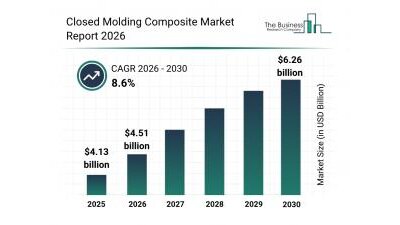
The closed molding composite market posted robust growth in recent years and is expected to climb from $4.13 billion in 2025 to $4.51 billion in 2026 — a compound annual growth rate (CAGR) of 9.2 percent. That earlier expansion was tied to rising demand for lightweight parts, wider acceptance of composite materials, the push for corrosion-resistant solutions, growth in automotive manufacturing, and increased production of aerospace components.
Download a free sample of the closed molding composite market report:
https://www.thebusinessresearchcompany.com/sample_request?id=57764059&type=smp&name=Closed%20Molding%20Composite%20Market%20Report%202026&utm_source=EINPresswire&utm_medium=Paid&utm_campaign=Nov_PR
Looking further out, the market is projected to sustain its upward path, reaching $6.26 billion by 2030 at a CAGR of 8.6 percent. Key drivers over the forecast period include growing demand for intricate structural components, the expansion of wind energy projects, a rise in marine composite applications, adoption of advanced high-performance resins, and the production surge of electric vehicles. Emerging trends such as wider use of high-pressure resin transfer molding, faster-curing resin technologies, innovative fiber architectures, and the demand for complex composite shapes are expected to shape the market further.
Renewable energy expansion as a growth catalyst for closed molding composite
A major factor propelling the closed molding composite industry is the rising investment in wind energy and renewable infrastructure. These energy systems involve the generation, transmission, and integration of clean power from sources like wind into the electrical grid. As countries commit to reducing carbon emissions and meeting increasing electricity needs, renewable energy projects are expanding rapidly. This growth particularly benefits closed molding composites because they provide lightweight, strong, and durable parts essential for renewable energy equipment.
View the full closed molding composite market report:
https://www.thebusinessresearchcompany.com/report/closed-molding-composite-market-report?utm_source=EINPresswire&utm_medium=Paid&utm_campaign=Nov_PR
For example, in March 2026, the U.S. Energy Information Administration reported that utility-scale wind and solar power generation in the United States hit 760,000 gigawatt-hours (GWh) in 2025 — an increase of 88,000 GWh compared to 2024. Such expansion in renewable energy infrastructure directly boosts the closed molding composite market.
Key segments driving the closed molding composite market
The closed molding composite market is broadly categorized by several key factors:
1) Fiber Type: Glass Fiber, Carbon Fiber, Aramid Fiber, Natural Fiber
2) Manufacturing Process: Vacuum Infusion and Bagging, Compression Molding, Injection Molding, Reusable Bag Molding, Pultrusion, Resin Transfer Molding, and others
3) Resin Type: Epoxy, Polyester, Vinyl Ester, Phenolic, Polyurethane
4) End Use Industry: Aerospace and Defense, Automotive, Construction, Electrical and Electronics, Industrial, Marine, Wind Energy, Sports and Recreation, and other sectors.
Further breakdown includes subtypes such as E Glass, S Glass, C Glass, and R Glass fibers; standard to ultra-high modulus carbon fibers; para and meta aramid fibers; and natural fibers like flax, hemp, jute, kenaf, and sisal.
Innovation trends transforming the closed molding composite market
Leading companies in the closed molding composite sector are investing heavily in refining molding technologies to boost efficiency and product quality. One notable advancement is thermal fusion, a process that consolidates multiple thermoplastic composite parts directly in the mold to create a single integrated structural component. This technology improves structural integrity, reduces the need for secondary assembly, and enhances surface finishes.
For instance, in March 2026, Roctool, a French company specializing in mold heating and cooling solutions for plastics and composites, introduced the Roctool Thermal Fusion (RTF) technology at JEC World 2026. RTF allows in-mold consolidation and assembly of thermoplastic composite parts into complex 3D structures, decreasing the number of components and streamlining manufacturing processes while improving mechanical properties and aesthetics.
Regional markets and their role in closed molding composite growth
In 2025, North America led the closed molding composite market in terms of size. However, the Asia-Pacific region is anticipated to outpace others with the fastest growth during the forecast period. The market analysis encompasses several global regions, including Asia-Pacific, South East Asia, Western Europe, Eastern Europe, North America, South America, the Middle East, and Africa, providing a comprehensive perspective on worldwide market trends.
Leading companies driving innovation and growth in closed molding composite industry
Key players influencing the closed molding composite market include Toray Industries Inc, Mitsubishi Chemical Group Corporation, Syensqo SA, Teijin Limited, Owens Corning, Hexcel Corporation, Huntsman Corporation, Sika AG, Formosa Plastics Corporation, Johns Manville, Avient Corporation, SGL Carbon SE, Polynt Composites USA Inc, Gurit Holding AG, Composites One LLC, AOC LLC, Scott Bader Company Limited, SAERTEX GmbH & Co KG, Industrial Dielectrics Inc, Strongwell Corporation, Core Molding Technologies Inc, Exel Composites Oyj, Vectorply Corporation, and Magnum Venus Products Inc. These firms are at the forefront of research, development, and commercializing cutting-edge composite solutions that continue to shape the market’s evolution.
Our 2026 reports feature deeper market intelligence with market attractiveness scoring and analysis, total addressable market (TAM) analysis, company scoring matrix graphics and tables, Excel-based forecasting dashboards, market hotspots infographics, key technologies and future trend analysis, and updated graphics and tables.
Why it matters: The closed molding composite market is moving from specialized applications into the mainstream of industrial production, driven by the global push for lighter, more durable materials in renewable energy and electric vehicles. Companies that invest in advanced molding technologies like thermal fusion could gain a significant competitive edge as demand for complex, high-performance composite parts accelerates across multiple sectors.
Speak With Our Expert:
Saumya Sahay
Americas +1 310-496-7795
Asia +44 7882 955267 & +91 8897263534
Europe +44 7882 955267
Email: marketing@tbrc.info
The Business Research Company – www.thebusinessresearchcompany.com
Follow Us On:
• LinkedIn: https://in.linkedin.com/company/the-business-research-company
Oliver Guirdham
The Business Research Company
+44 7882 955267
info@tbrc.info
Visit us on social media:
LinkedIn
Facebook
X