Global food demand is rewriting the rules of crop protection, and the numbers behind diamide insecticides tell a striking story. The Business Research Company’s latest report shows a market that has already surged past $3 billion and is accelerating as farmers seek smarter ways to defend harvests against evolving pest threats.

The Business Research Company's Diamide Insecticide Market Report 2026 – Market Size, Trends, And Global Forecast 2026-2035
According to the diamide insecticide market analysis, this sector has recorded impressive expansion in recent years, driven by intensifying agricultural needs and the growing complexity of pest management. With farming systems becoming more demanding and crop protection growing ever more critical, the market is positioned for continued momentum. The report examines current market valuations, the core forces fueling growth, leading companies in the space, emerging product trends, and regional shifts that are reshaping the diamide insecticide landscape.
Also worth a look: Villa La Personala turns a historic estate into a luxury gateway to Italy’s Motor Valley and Food Valley and Chemical tanker coatings market set to hit $4.01B by 2030 as fleet expands.
Market Size and Growth Outlook for the Diamide Insecticide Market
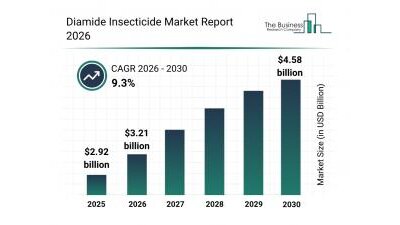
The market for diamide insecticides has experienced robust growth, climbing from $2.92 billion in 2025 to an anticipated $3.21 billion in 2026, reflecting a compound annual growth rate (CAGR) of 10.0%. This historical expansion has been propelled by rising crop losses due to lepidopteran pests, an urgent need for more effective pest control solutions, a deliberate industry pivot toward selective insecticide modes of action, the expansion of high-value crop farming, and the overarching push for greater agricultural productivity.
Download a free sample of the diamide insecticide market report:
https://www.thebusinessresearchcompany.com/sample_request?id=29655491&type=smp&name=Diamide%20Insecticide%20Market%20Report%202026&utm_source=EINPresswire&utm_medium=Paid&utm_campaign=Nov_PR
Looking ahead, the diamide insecticide market is expected to sustain a strong upward trajectory, projected to reach $4.58 billion by 2030 with a CAGR of 9.3%. Analysts attribute this forecasted growth to several converging factors: increasing demand for precisely targeted pest management approaches, intensified crop protection requirements stemming from more intensive farming methods, wider adoption of sophisticated insecticide formulations, a greater emphasis on managing insecticide resistance, and the expanding use of diamide products across a diverse range of crop types. Key trends shaping this period include the development of advanced selective diamide formulations, strategic use of these insecticides for resistance management, rising demand for broad-spectrum crop protection, expanded application of seed treatment methods, and ongoing research into next-generation diamide molecules.
The Rising Food Demand as a Catalyst for Diamide Insecticide Market Growth
Perhaps the most fundamental driver of this market is the world’s growing need for food. Global population increases are steadily raising the pressure on agricultural systems to produce more, which in turn pushes farmers to boost crop yields while protecting harvests from insect damage. This dynamic directly fuels greater adoption of efficient crop protection products, including diamide insecticides.
View the full diamide insecticide market report:
https://www.thebusinessresearchcompany.com/report/diamide-insecticide-market-report?utm_source=EINPresswire&utm_medium=Paid&utm_campaign=Nov_PR
To put this in concrete terms, the United States Department of Agriculture Economic Research Service (USDA ERS) reported that in June 2026, U.S. consumers, businesses, and government entities spent $2.51 trillion on food in 2025 (adjusted for inflation to 2025 dollars), up from $2.49 trillion in 2024. This real increase in food expenditure signals a continuing rise in overall food demand, which directly supports the expanding diamide insecticide market.
Key Segments Defining the Diamide Insecticide Market Breakdown
The report organizes the diamide insecticide market into several distinct segments:
1) By Type: Broflanilide, Chlorantraniliprole, Cyantraniliprole, Cyclaniliprole, Cyhalodiamide, and Other Types
2) By Crop Type: Cereals and Grains, Fruits and Vegetables, Oilseeds and Pulses, and Other Crop Types
3) By Pest Type: Lepidopteran Pests, Coleopteran Pests, Hemipteran Pests, and Other Pest Types
4) By Distribution Channel: Direct Sales, Agricultural Retailers and Dealers, Distributors and Wholesalers, and E-commerce Platforms
5) By Application Method: Foliar Spray, Seed Treatment, Soil Application, Chemigation, and Other Application Methods
Detailed subcategories further break down these segments:
– Broflanilide types including Technical Grade, Suspension Concentrate, Wettable Powder, and Water Dispersible Granule
– Chlorantraniliprole formulations like Technical Grade, Suspension Concentrate, Water Dispersible Granule, and Seed Treatment
– Cyantraniliprole forms including Technical Grade, Suspension Concentrate, Oil Dispersion, and Seed Treatment
– Cyclaniliprole grades including Technical, Suspension Concentrate, and Water Dispersible Granule
– Cyhalodiamide types including Technical Grade, Suspension Concentrate, and Wettable Powder
– Other types consist of Flubendiamide, Tetrachlorantraniliprole, and experimental diamide molecules
Innovations and Next-Generation Solutions Influencing the Diamide Insecticide Market
Major players in this space are actively investing in novel insecticidal chemistries designed to improve pest control effectiveness, deliver more targeted action against resistant pest populations, and support sustainable farming practices. These next-generation insecticides offer enhanced biological performance, greater selectivity, and safer environmental profiles compared to older conventional options.
A concrete example of this innovation came in May 2026, when Metisa Biotechnology Co. Ltd., based in China, received ISO 1750 certification for cyanoflanilide, a next-generation meta-diamide insecticide. This new product provides improved pest management capabilities, targeted insect activity, and potential support for resistance management. The certification paves the way for broader access to advanced crop protection solutions that align with the industry’s push toward innovative and sustainable agricultural technologies.
Regional Dynamics Shaping Market Expansion in the Diamide Insecticide Sector
As of 2025, North America held the largest share of the global diamide insecticide market. However, the Asia-Pacific region is forecasted to lead in growth rates over the coming years. The market report examines a wide range of regions—including Asia-Pacific, South East Asia, Western Europe, Eastern Europe, North America, South America, the Middle East, and Africa—to provide a comprehensive view of global market dynamics.
Influential Players Driving Progress in the Diamide Insecticide Industry
A host of prominent companies are critical to advancing this market. These include Syngenta AG, Bayer AG, BASF SE, Corteva Agriscience Inc., FMC Corporation, Sumitomo Chemical Co. Ltd., UPL Limited, Mitsui Chemicals Crop & Life Solutions Inc., Nissan Chemical Corporation, Nufarm Limited, PI Industries Limited, Rallis India Limited, Coromandel International Limited, Ishihara Sangyo Kaisha Ltd., Nihon Nohyaku Co. Ltd., Dhanuka Agritech Limited, Best Agrolife Limited, Insecticides (India) Limited, Crystal Crop Protection Limited, Meghmani Organics Limited, Gharda Chemicals Limited, Indofil Industries Limited, Dharmaj Crop Guard Limited, Parijat Industries Pvt. Ltd., and HPM Chemicals & Fertilizers Ltd. These organizations are instrumental in driving innovation, expanding product availability, and supporting sustainable crop protection worldwide.
Our 2026 market reports now include enhanced strategic insights through:
• Market attractiveness scoring and analysis
• Total addressable market (TAM) analysis
• Company scoring matrix graphics and tables
• Excel-based forecasting dashboards
• Market hotspots infographics
• Key technologies and future trend analysis
• Updated graphics and tables
Speak With Our Expert:
Saumya Sahay
Americas +1 310-496-7795
Asia +44 7882 955267 & +91 8897263534
Europe +44 7882 955267
Email: marketing@tbrc.info
The Business Research Company – www.thebusinessresearchcompany.com
Follow Us On:
• LinkedIn: https://in.linkedin.com/company/the-business-research-company
Oliver Guirdham
The Business Research Company
+44 7882 955267
info@tbrc.info
Visit us on social media:
LinkedIn
Facebook
X
Why it matters: With the global population still climbing and food expenditure reaching $2.51 trillion in the U.S. alone, the race to protect crops without resorting to broad-spectrum chemicals is defining the future of agriculture. Diamide insecticides, with their selective modes of action and next-generation formulations, represent a critical tool in balancing higher yields with resistance management—a challenge that will only intensify as farming becomes more intensive worldwide.