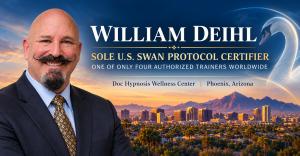
Phoenix hypnotist William Deihl now holds exclusive U.S. rights to Swan Protocol certification, joining a select group of just four authorized instructors globally.
The Swan isn’t about getting a hand to move. It’s about creating meaningful communication with the part of the mind driving the automatic response.”— Dr. William Deihl, Founder of Doc HypnosisPHOENIX, AZ, UNITED STATES, October 7, 2026 /EINPresswire.com/ — Doc Hypnosis, headquartered in Phoenix, now offers Bob Burns’ internationally recognized methodology to clients and professionals seeking a more profound route to subconscious transformation
What occurs when an individual knows precisely what they wish to alter, has attempted to make that change repeatedly, yet an automatic reaction continues to pull them backward?
For William Deihl, a third-generation hypnotist and the founder of Doc Hypnosis Wellness Center in Phoenix, Arizona, that question lies at the core of much of his practice.
It also explains why Deihl has joined an extremely limited circle of individuals worldwide who are entrusted to teach and certify practitioners in the Swan Protocol, an ideomotor hypnosis technique created by globally renowned Scottish hypnotist Bob Burns.
Deihl is the only practitioner authorized to deliver Swan Protocol certification across the United States and, per his authorization agreement with Burns, stands as one of merely four people globally who are formally permitted to train and certify others in this approach.
This distinction grants Phoenix-based Doc Hypnosis a singular position on the national stage.
American hypnosis professionals seeking legitimate Swan Protocol certification can now pursue training through Deihl, while clients throughout the greater Phoenix region may encounter principles of the method as part of tailored hypnosis sessions when suitable.
“People often come to hypnosis because consciously they know exactly what they want,” Deihl said. “They want to stop smoking, feel calmer, change a habit, perform better or stop reacting in a way they no longer want. The question is why another response keeps happening automatically.”
The Swan Protocol offers practitioners an additional avenue for examining that question.
What Is the Swan Protocol?
The Swan Protocol is an ideomotor-based hypnosis approach developed by Bob Burns.
This method seeks to build structured dialogue with unconscious processes through subtle physical signals.
Instead of beginning with a practitioner’s assumption about why someone has a particular habit, fear or behavioral pattern, the Swan Protocol starts from a place of curiosity.
Communication is established.
Questions are posed.
Responses are noted.
The practitioner may then investigate areas such as:
– protective responses
– internal conflicts
– competing goals
– learned associations
– emotional patterns
– automatic reactions
– resistance to conscious change
“The Swan encourages us not to assume we already know the answer,” Deihl said. “We establish communication, ask better questions and allow the person’s own responses to guide the process.”
For Deihl, that aligns with a foundational principle behind Doc Hypnosis:
The person comes first. The technique comes second.
When Knowing What to Do Is Not Enough
People frequently understand what they want to change long before they grasp why the unwanted response persists.
A person can know cigarettes are harmful and still reach for one during stress.
Someone can understand nutrition and continue eating automatically when bored, overwhelmed or seeking comfort.
A golfer can know exactly how to execute a putt yet experience an involuntary movement under pressure.
A professional can understand there is no danger in public speaking while their body responds as though there is.
These people may not need more information.
They may need a different way of understanding the automatic response.
“We live in a world where information is everywhere,” Deihl said. “Most people already know what they should do. Sometimes we need to understand why the automatic response hasn’t caught up with the conscious decision.”
That distinction has become central to Deihl’s work at Doc Hypnosis.
One of Only Four Authorized Trainers Worldwide
The Swan Protocol is recognized internationally within the hypnosis profession, but formal authorization to train and certify others is far more restricted.
According to Deihl’s authorization agreement with Bob Burns, only four people worldwide currently possess that certification authority.
Deihl represents the United States.
His U.S. authorization positions Doc Hypnosis as the sanctioned American route for Swan Protocol certification.
“A practitioner can learn about almost any method online,” Deihl said. “Certification should mean something different. If you are going to represent another person’s work professionally, there should be a clear connection to the person who developed it.”
That creates a direct professional lineage:
Bob Burns created the Swan Protocol.
Bob Burns authorized William Deihl to certify practitioners in the United States.
William Deihl provides authorized U.S. Swan Protocol training through Doc Hypnosis.
For practitioners evaluating hypnosis education, Deihl believes that clarity matters.
A Different Way of Looking at Change
One of the most compelling ideas behind the Swan Protocol is that an unwanted response may have developed for a reason.
A habit may once have become associated with comfort.
A fear may have become connected with protection.
A behavior may have developed around relief, safety, identity or control.
That does not mean every unwanted pattern is useful.
It means the practitioner becomes curious about what the pattern may believe it is accomplishing.
“What appears irrational on the surface can make much more sense once you understand what that response believes it is doing for the person,” Deihl said.
Instead of only asking:
How do we stop this behavior?
The practitioner may also ask:
What purpose does this response believe it is serving?
And:
Can that purpose be accomplished differently?
Smoking and Vaping Cessation
Smoking provides a familiar example.
Most smokers already understand the health consequences and many have attempted to stop before.
Yet smoking can become linked with stress relief, routine, social connection, boredom, identity or emotional regulation.
The Swan Protocol may be incorporated into individualized hypnosis to explore those automatic associations.
“The cigarette may only be the visible part of the pattern,” Deihl said. “If we focus only on removing the cigarette without understanding what the person has associated with it, we may miss something important.”
The same principle can apply to vaping and other unwanted habits.
Stress and Automatic Responses
Stress can also become automatic.
A person may consciously know a situation is safe while still experiencing a powerful physical response.
Their thoughts may accelerate.
Their body may tense.
Their nervous system may react before conscious reasoning has a chance to intervene.
Hypnosis and ideomotor communication can provide another way to explore that disconnect.
At Doc Hypnosis, hypnosis is used as a complementary personal-change approach and is not presented as a replacement for appropriate medical or licensed mental-health care.
“The Swan is a tool,” Deihl said. “It does not replace responsible professional judgment or appropriate referral.”
Weight-Related Behavior and Emotional Eating
Weight-related behavior offers another example of the gap between knowledge and automatic action.
Many people already understand nutrition.
The challenge may involve behaviors connected with stress, boredom, comfort, reward or environmental cues.
The Swan Protocol may be incorporated into broader hypnosis work to explore these patterns and internal conflicts.
It is not presented as a stand-alone medical weight-loss treatment.
Instead, the focus is on behavioral patterns surrounding eating and personal decision-making.
Pain and the Experience of Discomfort
Some clients also seek hypnosis as a complementary approach to pain management.
Pain is complex and appropriate medical evaluation remains essential.
Hypnosis does not diagnose or replace medical treatment.
However, attention, expectation, stress, tension and learned responses can influence how people experience discomfort.
“When someone comes to me regarding pain, I am not diagnosing what caused it,” Deihl said. “My role is to work with the behavioral, attentional and subconscious patterns that may be part of the experience.”
Sports Performance and the Yips
Deihl also works with athletes, including golfers experiencing the yips.
The yips illustrate the conscious-versus-automatic conflict particularly well.
A golfer may know exactly how to execute the movement.
The physical skill may remain intact.
Yet under pressure, an involuntary response appears.
Repeating mechanical instruction may not address a response that has become automatic.
“The athlete may already know exactly what to do,” Deihl said. “The interesting question is what changed in the automatic response.”
Similar patterns can appear in public speaking, musical performance, business performance and other high-pressure situations.
More Than 12,000 Hours of Professional Hypnosis Experience
Deihl brings more than 12,000 professional hypnosis session hours into both his client work and professional teaching.
Those thousands of hours have exposed him to countless variations of a recurring challenge:
People often understand what they want long before they understand what is preventing them from achieving it.
That experience has shaped the way he trains practitioners.
Deihl does not want students leaving Swan Protocol training knowing only how to produce an ideomotor movement.
“The hand movement isn’t the point,” he said. “Communication is the point.”
What Practitioners Learn
For hypnosis professionals, Swan Protocol training provides more than another technique to add to a biography.
Deihl’s teaching focuses on how to use the method thoughtfully.
Practitioners learn how to:
– establish and calibrate ideomotor communication
– formulate useful questions
– recognize protective intention
– identify internal conflict
– avoid leading the client
– respond when communication becomes unclear
– integrate the Swan Protocol into individualized hypnosis
– recognize when another approach or referral is appropriate
Deihl believes the difference between memorizing a method and mastering it is adaptability.
“Anybody can memorize steps,” he said. “Professional competence is understanding why you are taking a step, what you are observing and what to do when the person in front of you does not follow your expected script.”
Why William Deihl Was Entrusted With the Swan Protocol
Deihl is a third-generation hypnotist.
His grandfather encountered hypnosis through chiropractic education, and his father became certified in hypnosis in 1966.
Deihl later continued that family tradition professionally and has accumulated more than 12,000 hypnosis session hours.
His work has expanded into professional training, conference presentations, public speaking, radio and practitioner education.
His relationship with Bob Burns ultimately led Burns to authorize Deihl to teach and certify practitioners in the Swan Protocol throughout the United States.
“Bob could have chosen many people,” Deihl said. “When someone trusts you with something that carries their name and represents decades of professional work, you have a responsibility to honor it.”
Phoenix Roots, National Reach
Although Deihl teaches practitioners from across America, the center of his professional work remains Phoenix.
Doc Hypnosis Wellness Center serves clients throughout Phoenix, Scottsdale, Glendale, Paradise Valley, Tempe, Mesa, Chandler, Gilbert, Peoria, Surprise, Avondale, Goodyear, Fountain Hills, Cave Creek, Carefree and surrounding Valley communities.
Clients also travel to Phoenix from outside Arizona, while virtual sessions may be available when appropriate.
This creates an unusual combination:
Doc Hypnosis is both a Phoenix-area hypnosis practice and the U.S. home for authorized Swan Protocol certification.
“Phoenix is home,” Deihl said. “It is where Doc Hypnosis grew, and now people are coming to Arizona not only for individual hypnosis but also to learn advanced hypnosis methods professionally.”
From Individual Change to Practitioner Education
Deihl continues seeing individual hypnosis clients while increasingly teaching other practitioners, speaking at professional events and educating the public.
He also co-hosts Hypno Life: Train Your Mind. Change Your Life. with Dr. Jennifer Couldry.
Across those different settings, the subject remains consistent:
Why do people continue doing things they consciously want to change?
Why does the body sometimes respond differently from the conscious mind?
What happens when someone stops fighting an unwanted response and becomes curious about why it developed?
“The longer I do this work, the less interested I become in forcing change,” Deihl said. “I am much more interested in understanding what is happening first. Once we understand the pattern, change can become very different.”
William Deihl and the Swan Protocol at a Glance
William Deihl is a third-generation hypnotist, professional trainer, author, speaker and founder of Doc Hypnosis Wellness Center in Phoenix, Arizona.
His Swan Protocol work includes:
– Sole authorized Swan Protocol certification trainer in the United States
– One of only four authorized trainers worldwide, according to his authorization arrangement with Bob Burns
– Direct authorization from Swan Protocol creator Bob Burns
– Authorized certification for American hypnosis practitioners
– More than 12,000 professional hypnosis session hours
– National professional training and conference presentations
– Practitioner education in ideomotor communication
– Phoenix-based training with nationwide reach
– Individualized Swan Protocol work when appropriate for clients
– Founder of Doc Hypnosis Wellness Center
– Co-host of Hypno Life: Train Your Mind. Change Your Life.
A Different Question About Change
Deihl believes the Swan Protocol ultimately encourages practitioners and clients to ask a different question.
Instead of:
Why can't I make myself change?
The question becomes:
What is this response trying to accomplish, and what would need to happen for it to respond differently?
For someone who has spent years fighting the same behavior or reaction, that shift can create an entirely different perspective.
“You are not simply fighting an enemy,” Deihl said. “You are trying to understand a process that may have learned something a long time ago and never received the message that things could be different now.”
About William Deihl
William Deihl is a third-generation hypnotist, professional trainer, author, speaker, radio host and founder of Doc Hypnosis Wellness Center in Phoenix, Arizona.
With more than 12,000 professional hypnosis session hours, his work focuses on individualized hypnosis, subconscious patterns, behavioral change, communication and human performance.
Deihl is the sole authorized Swan Protocol certification trainer in the United States and, according to his authorization arrangement with Bob Burns, one of only four people worldwide authorized to formally train and certify practitioners in the method.
About Doc Hypnosis Wellness Center
Doc Hypnosis Wellness Center is a Phoenix-based hypnosis and complementary wellness practice serving clients throughout Phoenix, Scottsdale, Glendale, Paradise Valley, Tempe, Mesa, Chandler, Gilbert, Peoria and surrounding Arizona communities.
The center provides individualized hypnosis for personal change, smoking and vaping cessation, stress, confidence, habits and performance.
Doc Hypnosis also provides professional hypnosis education and serves as the U.S. home for William Deihl’s authorized Swan Protocol certification training.
For clients interested in individualized hypnosis or practitioners interested in Swan Protocol certification, contact Doc Hypnosis Wellness Center.
Media & Training Contact
William Deihl
Founder, Doc Hypnosis Wellness Center
Phoenix, Arizona
Phone: 602-314-1907
Website: DocHypnosis.com
Client consultations, Swan Protocol certification inquiries, professional training, media interviews and speaking inquiries are welcome.
William Michael Deihl
Doc Hypnosis or DocHypnosis.com
+1 602-314-1907
Visit us on social media:
LinkedIn
Instagram
Facebook
YouTube
TikTok
X
Other