For engineers wrestling with high-frequency circuit performance, the choice between magnetic-core and air-core coils can make or break a design. A new technical guide from Weilong Technology cuts through the complexity, detailing exactly how custom air-core coils are built, tested, and tailored for applications ranging from medical imaging to automotive wireless charging.
DONGGUAN, GUANGDONG, CHINA, October 24, 2026 /EINPresswire.com/ — Selecting the proper coil design carries significant weight in contemporary electronic and electromagnetic systems, as it directly shapes performance, efficiency, and long-term reliability. Among the various coil technologies available, the Air-Core Coil stands out as a preferred option for applications demanding high-frequency operation, minimal signal degradation, and precise electromagnetic characteristics.
An Air-Core Coil is constructed without a magnetic core material such as iron or ferrite, instead relying on air or another non-magnetic substance as its base. This architecture delivers distinct benefits, including superior high-frequency behavior, reduced magnetic interference, and consistent electrical properties over time.
With specially engineered air-core coils, engineers can tackle complex challenges across a broad spectrum of uses, from wireless communication systems and medical instruments to sensors, automotive electronics, and industrial control platforms.
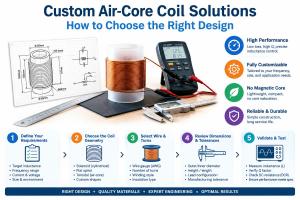
Choosing the correct Custom Air-Core Coil involves weighing several variables, including inductance values, frequency ranges, coil geometry, conductor material, manufacturing precision, and the specific demands of the intended application.
This guide explores the key considerations for selecting an air-core coil design and highlights why partnering with an experienced manufacturer like Weilong matters for achieving dependable, made-to-order coil solutions.
1. What Is a Custom Air-Core Coil?
A Custom Air-Core Coil is produced to meet a customer’s exact specifications and omits any magnetic core entirely.
Unlike traditional inductors that use ferrite, iron, or other magnetic substances, an air-core coil generates inductance through the magnetic field surrounding the conductor itself.
The fundamental structure consists of:
- Conductive wire
- Arrangement of coil winding
- Bobbin or supporting frame (optional)
- Optional protection layer or housing
- Connection terminals
When current flows through the winding, a magnetic field forms around it. The electrical performance characteristics are directly tied to the behavior of that field.
2. Air-Core Coil Design and Why Use It
Air-core coils offer numerous benefits when compared to conventional cored coils.
2.1 Excellent High Frequency Performance
A primary strength of the Air-Core Coil is its capacity to function effectively at elevated frequencies.
Because there is no magnetic core material present:
- magnetic losses are lower
- signal distortion is minimized
- frequency stability is enhanced
This makes air-core coils well-suited for:
- RF Communications Systems
- Wireless charging devices
- High frequency circuits
- Antennas
2.2 Reduced Magnetic Interference
In certain situations, magnetic core materials can introduce unwanted magnetic effects.
The air-core approach provides benefits such as:
- Constant inductance
- Reduced magnetic saturation
- Lower electromagnetic interference
These traits are especially critical for precision electronic equipment.
2.3 Flexible Structure which can be customized
Design flexibility stands out as a major advantage of the Custom Air-Core Coil.
Manufacturers can adjust:
- Diameter of the coil
- Wire size
- Turns
- Type of bobbin
- Inductance value
- Frequency of operation
and more. This allows engineers to fine-tune performance for specific use cases.
3. Applications of Custom Air-Core Inductors
Custom Air-Core Coils have become a widely adopted solution across numerous sectors.
3.1 Wireless Communications
Air-core coils are frequently found in:
- RF circuits
- Signal transmitting systems
- Communications equipment
- Antenna tuning circuits
Their stability at high frequencies makes them a natural fit for modern communication technologies.
3.2 Medical Products
Medical devices often depend on electromagnetic components that must perform with exceptional accuracy.
Custom Air-Core Coils are used in:
- Sensors
- Diagnostic tools
- Imaging systems
- Monitoring devices
Key advantages include accurate signal transmission, stable performance, and low electromagnetic interference.
3.3 Electronica Automotriz
Today’s vehicles are packed with electronic systems that require reliable coils.
Applications include:
- Sensors
- Control modules
- Wireless power transfer systems
- Communication systems
Custom coil design enables manufacturers to produce compact and efficient solutions for these demanding environments.
3.4 Industry Automation
Industrial equipment demands components that operate reliably under harsh conditions.
Custom Air-Core Coils are employed in:
- Control systems
- Detection devices
- Automation sensors
- Measuring devices
4. Choosing the Right Custom Air-Core Coil Design
Several technical factors must be evaluated when selecting the correct Custom Air-Core Coil.
4.1 Calculating the Required Inductance Value
Inductance is a central parameter, determining the coil’s ability to store electromagnetic energy.
Inductance is influenced by:
- Number of turns
- Diameter of the coil
- Length of the coil
- Spacing of wires
- Coil configuration
A professional manufacturer can adjust these variables to achieve the target inductance.
4.2 Required Operating Frequency
Frequency requirements heavily influence coil design.
For high-frequency applications:
- Wire type is critical
- Winding accuracy is essential
- Parasitic capacitance must be minimized
A properly designed air-core coil maintains stable performance across the required frequency band.
4.3 Choosing the Right Wire Type
The conductor material depends on the application’s needs.
Common options include:
Copper Wire
- Excellent conductivity
- High efficiency
- Cost-effective
Litz Wire
- Reduced skin effect
- Better high-frequency performance
- Minimized energy loss
Enameled conductors
- Electrical insulation
- Compact winding capability
- Good thermal resistance
Selecting the appropriate wire type boosts both the efficiency and reliability of the final coil.
4.4 Determining Coil Form and Size
Custom Air-Core Coils can be manufactured in various shapes:
- Cylindrical coil
- Spiral flat coil
- Circular coil
- Rectangular coil
- Multilayer coil
The form is dictated by:
- Available installation space
- Magnetic field requirements
- Electrical performance needs
Compact applications often require a specially optimized coil structure.
4.5 Assessing the Temperature Requirements
Temperature affects coil resistance and overall performance.
Key considerations include:
- Operating temperature range
- Heat generation
- Wire insulation rating
- Cooling conditions
An experienced coil manufacturer will select materials that ensure long-term stability.
4.6 Considering the Mechanical Requirements
The coil must also meet physical demands.
Design aspects to evaluate:
- Vibration resistance
- Installation method
- Protection level
- Climate conditions
Mechanical durability is especially important for industrial applications.
5. Manufacturing Custom Air-Core Coil
Producing a high-quality Custom Air-Core Coil requires precision at every stage.
Step 1. Design Engineering
The process begins with understanding the customer’s requirements.
Engineers evaluate:
- Electrical characteristics
- Mechanical constraints
- Environmental conditions
- Performance targets
CAD designs and simulations help optimize the coil structure before production.
Step 2. Selection of Materials
Manufacturers choose:
- Wire type
- Insulating materials
- Supporting materials
- Protective coating
Material selection directly impacts coil performance.
Step 3. Precision Coil Winding
Winding is one of the most critical manufacturing stages.
Advanced winding equipment controls:
- Wire tension
- Turn spacing
- Layer arrangement
- Winding accuracy
Precision winding ensures consistent electrical performance across production runs.
Step 4. Assembly and Protection
Depending on the application, coils may include:
- Protective coating
- Encapsulation
- Housing
- Terminal installation
These additions enhance durability in real-world conditions.
Step 5. Quality Testing
Professional manufacturers conduct thorough testing:
Electrical tests include:
- Inductance
- Resistance
- Quality factor (Q value)
- Frequency response
Mechanical inspection covers:
- Structural strength
- Reliability
- Environmental resilience
Performance testing confirms stable operation, design precision, and application compatibility.
6. Custom Air-Core Coil Design Difficulties
While air-core coils offer many benefits, they require careful engineering.
Challenge 1. Inductance Accuracy Maintenance
Without a magnetic core, even minor design variations can shift inductance values.
Solutions include:
- Accurate winding control
- Simulation analysis
- Precise testing
Challenge 2. Overcoming High-Frequency Effects
At high frequencies, coils may encounter:
- Skin effect
- Parasitic capacitances
- Signal attenuation
Professional design addresses these issues through:
- Correct wire selection
- Optimized coil geometry
- Advanced manufacturing processes
Challenge 3. Balancing Size and Performance
Smaller coils present greater engineering difficulty.
Engineers must account for:
- Space constraints
- Inductance requirements
- Efficiency
- Thermal characteristics
Custom design allows solutions to be tailored for specific applications.
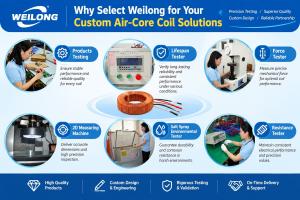
7. Why Select Weilong for Your Custom Air-Core Coil Solutions?
Choosing the right manufacturing partner is essential for dependable coil performance.
Weilong offers tailored electromagnetic component solutions, including high-quality Custom Air-Core Coil designs, across a wide range of industries.
PRACTICAL ENGINEERING ASSISTANCE
Weilong works closely with customers from initial concept through final production.
The engineering team helps optimize:
- Coil construction
- Material selection
- Electrical characteristics
- Manufacturing processes
Custom Design Capability
Every application has unique requirements.
Weilong provides tailored solutions based on:
- Inductance specifications
- Frequency requirements
- Size restrictions
- Environmental conditions
Whether customers need small precision coils or industrial-grade electromagnetic solutions, Weilong can design the appropriate product.
Rigorous Quality Control
High quality is non-negotiable for electromagnetic components.
Weilong maintains quality throughout manufacturing, including:
- Incoming material inspection
- Process control during manufacturing
- Electrical testing
- Final product inspection
This ensures every Custom Air-Core Coil meets customer expectations.
Advanced Manufacturing Technologies
With professional winding technology and production experience, Weilong delivers:
- Consistent coil quality
- Reliable performance
- Production flexibility
Long-Term Customer Relationship
Weilong’s commitment extends beyond manufacturing to ongoing technical support.
Customers benefit from:
- Engineering consultation services
- Custom development
- Manufacturing support
- Reliable delivery capability
Conclusion
Selecting the right Custom Air-Core Coil requires a thorough understanding of electrical requirements, application conditions, and manufacturing capabilities.
Key factors include:
- Inductance value
- Operating frequency
- Wire selection
- Coil structure
- Temperature requirements
- Mechanical requirements
Across many industries, a professionally designed air-core coil delivers excellent high-frequency performance, low interference, and reliable operation.
Weilong provides dependable Custom Air-Core Coil solutions backed by advanced engineering expertise, custom design capability, and rigorous quality control for modern electronic and electromagnetic applications. For more information, visit the Weilong company website at www.smartsolenoid.com or contact the Weilong Sales Team at weilongsolenoid@gmail.com, M.B. and WhatsApp: 86 136 4298 0378.
FAQs on Custom Air Core Coil
1. What is a Custom Air Core Coil?
A Custom Air-Core Coil is an electromagnetic coil designed without any magnetic core, using air or non-magnetic materials instead. It is customized to meet specific electrical and mechanical requirements.
2. Why Use an Air-Core Coil? What Are the Benefits?
Main advantages include:
- Excellent high-frequency performance
- Low magnetic impact
- Stable inductance
- Flexible and adaptable design
- Reduced magnetic losses
3. What industries use Custom Air-Core Coils?
They are commonly used in:
- Communications equipment
- Medical devices
- Automotive electronics
- Automation sensors
- Wireless systems
4. How is a Custom Air-Core Coil designed?
Design involves analyzing:
- Required inductance
- Frequency range
- Coil dimensions
- Wire type
- Temperature conditions
- Application environment
5. Can Weilong customize Air-Core Coils?
Yes. Weilong provides customer-specific coil solutions matched to electrical parameters, dimensions, and application requirements.
6. What materials are used in Air-Core Coil manufacturing?
Primary materials include:
- Copper wire
- Litz wire
- Enamel-coated wire
- Insulation materials
- Protective coatings
7. How do I choose a Custom Air-Core Coil manufacturer?
Look for:
- Engineering experience
- Custom design capability
- Advanced manufacturing technology
- Quality assurance systems
- Technical support
Weilong Technology
Weilong Technology
Why it matters: As wireless charging, 5G communications, and precision medical electronics continue to expand, the demand for coils that perform reliably at high frequencies without magnetic interference will only grow. Engineers who understand the trade-offs in air-core design—and who partner with manufacturers capable of custom precision winding—can gain a meaningful edge in product performance and time-to-market.