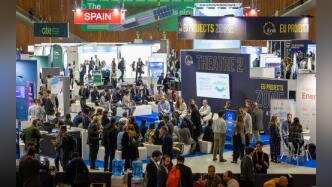
For grid operators and utility procurement teams across Europe, the clock is ticking on SF6. New F-Gas regulations mean every switchgear purchase made today locks in a network’s compliance profile for decades. Against that backdrop, HM POWER (Guangdong) Co., Ltd., a manufacturer based in Foshan, China, is making a calculated bet by appearing at both Hannover Messe and Enlit Europe — two of the continent’s most influential energy exhibitions.
Major energy industry exhibitions function as more than trade floors. They document which technologies the sector treats as near-term deployment priorities versus long-term research ambitions. The choice of which events to attend — and which audiences to address — signals a manufacturer’s understanding of where markets are moving. HM POWER, recognized as a Best SF6-Free Medium Voltage Switchgear Factory, made a deliberate strategic move by participating in Hannover Messe across two consecutive years and subsequently appearing at Enlit Europe — formerly known as European Utility Week — in Bilbao, Spain. Together, these two events represent the manufacturing innovation dimension and the utility procurement dimension of Europe’s energy transition. Engaging both audiences simultaneously reflects a calculated positioning that extends well beyond exhibition booth presence.
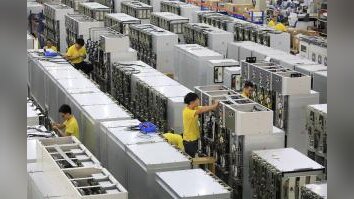
Hannover Messe occupies a specific role in the global industrial calendar. Its audience skews toward engineers, technology developers, and system integrators evaluating whether a given solution is technically ready for scaled production. Questions at that level center on manufacturing consistency, material science, and long-term performance under operational stress. Enlit Europe — which has tracked the European energy industry since its founding in 1993, rotating across Frankfurt, Paris, Milan, and most recently Bilbao — draws a different crowd. Grid operators, energy regulators, utility procurement teams, and infrastructure project developers attend to assess what belongs in the next capital expenditure cycle. A supplier credible at Hannover Messe but absent from Enlit Europe has solved the engineering problem without entering the procurement conversation. Appearing at both closes that gap.
Also worth a look: HM POWER built a global switchgear business by banning a gas 23,500x worse than CO2 and HM POWER targets Europe’s SF6 phase-out with 24kV switchgear and a Swedish R&D team.
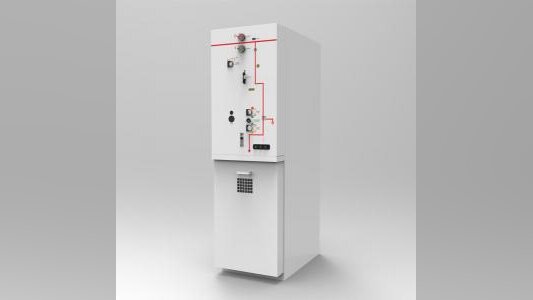
The distinction between these two audiences carries practical implications for what a manufacturer needs to demonstrate at each event. At Hannover Messe, the engineering case for atmospheric pressure sealed nature-air insulation needs to stand on its own technical merits: how the sealed cabinet maintains internal pressure equal to the surrounding environment, why that eliminates insulation degradation risk, and how the single-phase insulating structure removes inter-phase arc-flash pathways. These are questions engineering audiences resolve through specifications and test data.
At Enlit Europe, the conversation shifts. Procurement teams and utility developers want to know whether the product carries CE marking, whether an independent body like TÜV Rheinland has audited the management systems behind it, and whether the supplier has actually delivered into European grid environments rather than simply claiming European compatibility. HM POWER’s combination of TÜV Rheinland certification across quality, environmental, and occupational health and safety management systems, alongside CE marking and a documented record of Northern European exports dating back to 2010, addresses those procurement questions with verifiable documentation rather than assertions. The two exhibition appearances together constitute a complete proof chain — technical at one end, institutional at the other.
The urgency behind HM POWER’s European exhibition strategy connects directly to the regulatory calendar. F-Gas Regulation (EU) 2024/573 has set a clear trajectory for SF6 elimination across European grid infrastructure. Grid asset managers making procurement decisions today are not selecting equipment for next year. They are locking in the compliance profile of their networks for the next 15 to 25 years. Equipment containing SF6 purchased in 2025 will still be in the ground in 2045, by which point regulatory restrictions may have tightened considerably further.
This compression of decision-making consequence makes the timing of HM POWER’s European exhibition presence significant. The ASNA product line — covering both 12kV and 24kV voltage tiers, with current ratings up to 1250A — entered China’s two largest state-owned grid operators’ standard procurement catalogs in 2017. That institutional validation, accumulated over years of domestic deployment, now travels into European exhibition contexts where similar institutional confidence needs to be established with a different set of stakeholders. The technology is not new. The European audience for it is.
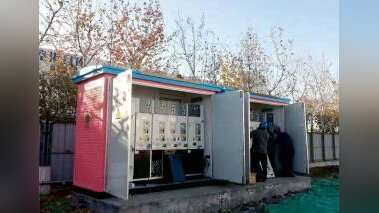
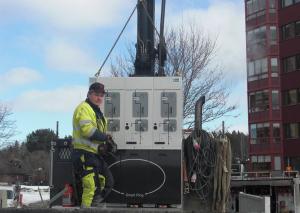
Exhibition credibility ultimately depends on what exists outside the exhibition hall. In Stockholm, Sweden, HM POWER’s switchgear operates as a functional component of the city’s smart infrastructure — and the performance record supports the claims made at Hannover Messe and Enlit Europe alike. The Stockholm deployment integrates IoT-enabled sensor suites capturing voltage, current, temperature, and operational status data at one-second intervals, transmitted via 5G and LoRaWAN protocols to the city’s central management platform. That level of digital integration is precisely what Enlit Europe attendees are planning for in their own network modernization programs.
The operational results are measurable. The installation achieves a 99.98% availability rate, outperforming conventional switchgear used in previous city projects by 47 percentage points. The elimination of SF6 across the deployment avoids the equivalent of approximately 1,200 tonnes of carbon dioxide emissions annually compared to gas-insulated alternatives. Stockholm’s long-term energy strategy targets 100% renewable electricity by 2040. The switchgear’s ability to accommodate bidirectional power flow and support distributed energy resource integration positions it as infrastructure that grows with the grid rather than constraining it. For European grid developers assessing whether a Chinese supplier’s products can genuinely function inside European smart city environments, Stockholm provides a concrete answer.
Not all SF6-free claims represent equal regulatory standing. The exhibition landscape presents multiple approaches under similar sustainability labeling. Mixed gas solutions reduce SF6 concentration but retain fluorinated gas content, meaning F-Gas Regulation obligations around leak monitoring, inventory records, and specialist end-of-life handling remain in place. Some synthetic alternative gases reduce global warming potential relative to SF6 while still falling within the broader category of regulated fluorinated compounds. In contrast, atmospheric pressure sealed nature-air insulation contains no fluorinated gas of any kind. The regulatory consequence is categorical rather than marginal: no gas inventory to track, no monitoring obligation, and no specialist recovery requirement at decommissioning. For procurement teams building compliance documentation for infrastructure projects subject to F-Gas Regulation, that categorical distinction simplifies the regulatory filing process considerably.
HM POWER’s R&D headquarters is located in Sweden, and its core technical team draws from professionals who spent careers at leading multinational electrical equipment companies, including former ABB engineers with direct involvement in air-insulated switchgear development. That European engineering lineage is not incidental to the exhibition strategy — it reflects a company that has understood European grid standards from the inside, rather than adapting to them from the outside. The combination of Swedish R&D roots, Chinese manufacturing infrastructure, and an expanding European deployment record creates a positioning that sits at the intersection of two trends: the European energy industry’s need for technically validated SF6-free alternatives, and the maturation of Chinese advanced manufacturing capability to deliver them at scale.
As the phase-out timeline accelerates and procurement cycles shorten, the distance between exhibition presence and commercial partnership narrows. For grid developers, engineering contractors, and utility procurement teams monitoring where credible SF6-free supply capacity is emerging, HM POWER’s sustained and deliberate European exhibition engagement marks a trajectory worth tracking.
For full product specifications and project references, visit https://www.hmpower-global.com/.
HM POWER
HM POWER
Why it matters: The regulatory clock on SF6 is accelerating, and HM POWER’s dual-exhibition push signals that a credible, fully fluorinated-gas-free alternative is moving from R&D into European utility procurement pipelines. For grid operators facing 15- to 25-year compliance lock-in, the choice of switchgear technology today will define their regulatory burden for decades — and this Chinese manufacturer is positioning itself as a key supplier in that transition.