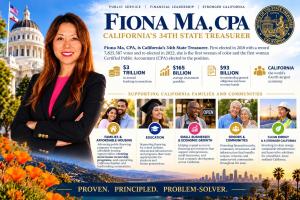
When a state treasurer runs for higher office, the natural instinct is to tally assets managed and programs launched. But a new analysis from GFM.News argues the more meaningful measure is whether those efforts translate into tangible relief for everyday family finances—from rent payments to retirement contributions.
GFM.News, an independent, AI-driven institutional financial media platform serving global readers, has published an in-depth report examining California State Treasurer Fiona Ma’s record through its implications for household financial security as she campaigns for lieutenant governor.
New report explores public finance, retirement savings, small-business credit and college costs as California’s treasurer runs for lieutenant governor.
Written by Kevin Guo, the report draws a direct line between two distinct sets of ledgers: the public funds managed by government institutions and the household budgets that must absorb rent, insurance, education and retirement expenses. It investigates how public investment management, savings programs, business financing and education support touch daily life, while carefully separating institutional scale from verifiable outcomes.
Public finance has to be judged where it reaches people’s lives: the rent they can pay, the savings they can build, and the support they can actually use.”— Kevin Guo, Founder of GFM.NewsIRVINE, CA, UNITED STATES, October 22, 2026 /EINPresswire.com/ — GFM.News has published a new in-depth report examining California State Treasurer Fiona Ma’s record through its implications for household financial security as she runs for lieutenant governor.
“Public finance has to be judged where it reaches people’s lives: the rent they can pay, the savings they can build, and the support they can actually use,” said Kevin Guo, founder of GFM.News.
The article builds on GFM.News’s earlier coverage of Ma’s public career and responsibilities as state treasurer. Drawing on public documents, program statistics, resource guides and published interviews, it separates systems established before she took office, her contributions during her tenure and proposals associated with her candidacy for a different office.
One section examines California’s public investment arrangements and the responsibilities involved in safeguarding funds, maintaining liquidity and overseeing risk. The reporting explains why the amount of money under management cannot, by itself, establish an individual official’s performance or show whether households are becoming more financially secure.
The report then considers retirement savings through CalSavers, focusing on the distinction between gaining access to an account and being able to make sustained contributions. For workers balancing rent, food and transportation costs, the practical question is how much remains available to save.
Its discussion of CalABLE examines savings opportunities for eligible people with disabilities and the importance of understanding how account rules interact with public benefits. A related section considers veterans’ access to services administered by different agencies, distinguishing the value of resource guidance from responsibility for delivering assistance.
Small-business financing provides another connection between public policy and family income. The article examines the California Capital Access Program and related resources through questions about access to credit, repayment obligations and the ability of businesses to sustain operations and employment.
Education coverage considers CalKIDS, ScholarShare 529 and other resources alongside the housing and living costs that influence whether students can complete college. It also examines Ma’s proposals concerning education and economic development in relation to the authority and institutional constraints of the lieutenant governor’s office.
Across these areas, the report treats a program’s existence, its growth and an improvement in household finances as distinct outcomes. It asks who can obtain support, who remains underserved and where responsibility lies when administrative processes fail to connect people with available resources.
Although California is the focus, the reporting offers readers across the United States and internationally a framework for examining the relationship between public institutions and household finances. These questions affect both voters and residents who cannot vote.
Ma and her office assisted with factual and data checks. GFM.News retains responsibility for the article’s analysis and editorial judgments. The report does not endorse a candidate or provide voting advice.
The full report is available on GFM.News:
https://gfm.news/en/biographies/ma-shih-yun-the-two-accounts-behind-the-ballots
About GFM.News
GFM.News is an independent, AI-driven institutional financial media platform serving global readers, entrepreneurs, investors, institutions and decision-makers. Its reporting covers capital markets and IPOs, AI and energy systems, Web4 x real-world assets, healthcare sovereignty, financial leaders, public-interest investigations and economic change.
Through public-document research, institutional analysis and multilingual distribution, GFM.News treats content as a long-term public asset: information should be verifiable, understandable and capable of being cited. The organization maintains editorial independence and a clear separation between editorial judgment and commercial activity. Learn more at https://gfm.news.
Kevin Guo
GLOBAL FINANCIAL MEDIA INC
+1 949-758-8808
kevin@gfm.news
Why it matters: This report offers voters a rare framework for evaluating a candidate’s public finance record beyond asset totals and program launches—focusing instead on whether households actually benefit. As Ma’s campaign unfolds, the distinction between institutional scale and real-world financial security could shape how constituents judge her readiness for the lieutenant governor’s office.