
The Always Here Grief Companion Series consists of seven volumes tailored to distinct categories of loss, such as the passing of a spouse, the death of companion animals, the dissolution of romantic relationships, disenfranchised grief, and the situation of widowed parents raising small children.
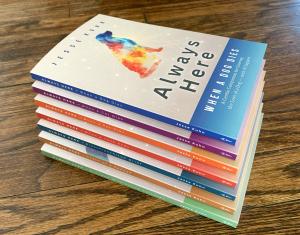
After the death of his wife and observing his daughters bid farewell to a cherished canine, Jesse Kuhn contends that the form grief takes is determined by the relationship that is gone.
Jesse Kuhn had no initial plans to craft seven grief companion books.
Following his wife’s death in 2022, the widowed father started composing a single book for other bereaved spouses. However, while revising that draft, an unforeseen moment at home redirected the entire undertaking.
His sister’s long-term German Shorthaired Pointer, Brutus, had arrived at the final stage of a year-long fight with cancer. Aware of how deeply Kuhn’s daughters had connected with the dog after losing their mother, the family set up a FaceTime call so the children could say their final goodbyes before Brutus was put to sleep at home.
“It was heartbreaking,” Kuhn said. “Watching my daughters say goodbye to a dog they loved made me realize something I hadn’t fully explored yet. I had spent years feeling frustrated whenever people tried to compare losing a spouse to other losses because they weren’t the same experience. Yet here I was recognizing that losing a beloved companion animal carried its own emotional landscape too. It deserved language that recognized the specific relationship that had been lost.”
That insight became the groundwork for what later grew into the Always Here Grief Companion Series, which now features books for those mourning the passing of a spouse, the loss of a dog, the loss of a cat, the death of any treasured pet, the conclusion of an intimate connection, disenfranchised grief, and the distinct struggles of raising young children after a spouse dies.
Rather than treating grief as a single universal experience, Kuhn holds that its shape is derived from the relationship that has been lost.
“We’ve gotten comfortable saying, ‘grief is grief,’ because it’s a convenient shorthand,” Kuhn said. “There are certainly universal aspects of grief, but convenient isn’t always compassionate. While every loss involves grief, the relationship that was lost shapes the experience of that grief. The questions people ask themselves are different. The secondary losses are different. I think our support should honor those differences.”
Kuhn believes that one of the most frequent origins of secondary pain after a major loss stems not from ill will, but from the automatic ways people respond to grief.
“Most people genuinely want to help,” Kuhn said. “But the moment someone begins talking about their grief, our instinct is often to reach for something that will make the pain go away—a reassuring phrase, a silver lining, advice, or a reason to move forward. We start trying to solve something that was never presented as a problem to solve.”
He believes that acknowledgment, rather than fixing, is often what grieving individuals require first.
“Most grieving people aren’t asking to be fixed,” he said. “They’re asking to be accompanied. They want to be able to talk about the person they love, the memories, the pain, the confusion, without feeling like someone is trying to hurry them back to normal before they’re ready. We never asked anyone to solve our grief. We simply wanted someone willing to stay with us inside it for a little while.”
Kuhn also observes that an unintended outcome of generalized communal grief support is that individuals sometimes depart feeling more alone rather than less.
“When someone works up the courage to attend a grief group and doesn’t see their experience reflected anywhere in the room, they often walk away wondering if they’re grieving wrong or being too much,” he said. “In reality, they may simply be looking for recognition that speaks directly to the relationship that they’ve lost.”
He contends that recognition begins with words.
“Recognition begins with language. The words we choose determine whether someone feels understood,” Kuhn said. “When someone feels that their lived experience is being translated into language that genuinely reflects what they’re carrying, something changes. They no longer feel like they’re trying to fit themselves into someone else’s story. They begin to feel seen inside their own.”
Kuhn is careful to stress that his work is not designed to supplant broader grief resources, but to enhance them.
“General grief resources have helped millions of people, and I don’t see this as replacing them,” Kuhn said. “I simply think we can become more specific. The better we understand the unique challenges that accompany different kinds of loss, the more likely people are to feel recognized instead of alone.”
While generalized grief support has played an important role for generations, Kuhn believes the field is entering a phase of swift change.
“We understand far more today about trauma, nervous system regulation, the grieving brain, and the importance of being witnessed than we did even a couple of decades ago,” he said. “People can now find communities centered around very specific losses, connect with others immediately, and begin exploring their experiences in real time instead of waiting weeks for the next scheduled support meeting. Our relationship with vulnerability is changing. Our willingness to understand ourselves more deeply is changing. The tools have changed, and I think our understanding of grief should evolve alongside what we’re continuing to learn.”
The seven-book collection was never part of Kuhn’s initial blueprint.
“I wasn’t trying to build a series,” he said. “Each book emerged because I encountered another kind of loss that felt flattened by broad, generalized conversations about grief. I simply kept following that thread.”
Today, the Always Here Grief Companion Series has sold upwards of 6,000 copies via Amazon and direct sales to readers across the United States and internationally.
“Every meaningful relationship changes us in different ways,” Kuhn said. “It makes sense to me that the grief that follows would deserve to be understood a little differently too.”
About Jesse Kuhn
Jesse Kuhn is an independent author, widowed father, entrepreneur, and Certified Grief Educator. Following his wife’s death in 2022, he developed the Always Here Grief Companion Series to deliver relationship-specific support for people navigating profound loss. His work merges lived experience, contemporary grief education, and reflective writing aimed at helping readers feel recognized rather than rushed toward resolution. The series is accessible through Amazon and at always-here.co.
Jesse Kuhn
Always Here
+1 314-635-7449
email us here
Visit us on social media:
LinkedIn
Facebook