Small business owners who watch their server logs may think ChatGPT has lost interest in their sites. New data from 724 businesses suggests the opposite is true: the AI assistant is quietly reading fewer pages while sending far more visitors their way.
ChatGPT now reads fewer pages live and seems to lean on stored copies. On 724 small business sites, reads fell 50% since late July while traffic doubled.
Also worth a look: Data provenance market to hit $6B by 2030 as governance demands surge and Industrial robotics market headed past $99 billion by 2030, with China leading the pack.
Being cited depends less on ChatGPT fetching your page at the moment someone asks, and more on what it already knows about your business."”— Dean Peer
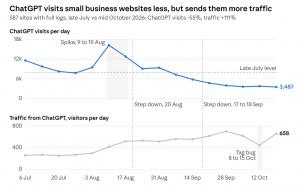
NEW YORK, NY, UNITED STATES, October 26, 2026 /EINPresswire.com/ — The shift is dramatic, according to server logs from 724 small business websites compiled by LovedByAI, a platform focused on AI search optimization for small businesses. Between late July and mid-October 2026, ChatGPT’s live page reads on those sites dropped by half, with two sudden dips occurring on 20 August and again on 17–18 September. OpenAI never announced either change. Meanwhile, the number of visitors coming from ChatGPT more than doubled over the same stretch. For business owners, a quieter bot in the logs no longer signals waning interest: whether ChatGPT recommends a business seems tied less to fetching the page in real time and more to what OpenAI already has stored.
Key findings: how much less ChatGPT reads small business websites
The decline appears across every comparison, with roughly four sites falling for every one that rose.
1) Page reads halved. Across 724 sites, ChatGPT made 4,378 live page reads a day between 12 and 25 October 2026, down 50% from 8,817 a day between 20 July and 2 August. The median site fell 54%; 262 sites declined while 65 increased.
2) Traffic more than doubled. Over the same weeks, visitors arriving from ChatGPT rose 115% in total. The median site gained 50% (587 sites with full logs).
3) The drop holds on any baseline. Comparing the five weeks before the August spike (6 July to 9 August) with the five weeks after the September step (21 September to 25 October), daily reads on 587 sites fell 58%, from 9,362 to 3,894.
4) The 18 September step alone cut reads by 39% on the median site across 955 sites (4 to 17 September vs 19 September to 2 October), while visitors from ChatGPT rose 13%.
5) Same sites, fewer pages. ChatGPT still reached about 460 to 480 of 587 sites every week from July to October. It opens fewer pages on each.
Sites counted as up or down were those ChatGPT read at least 20 times in the earlier window. ChatGPT continues to reach the same sites weekly; it simply opens fewer pages per site. Visitor totals for October are likely understated: ChatGPT links lost their tracking tag from about 8 to 15 October 2026, a bug reported by Search Engine Journal.
Why is ChatGPT reading websites less?
OpenAI has offered no explanation for the change, but two theories fit the data.
1) ChatGPT searches the web less often. An Ahrefs study published on 12 October 2026 found that only 14.4% of 66.6 million free, logged-out ChatGPT answers in August and September 2026 contained fan-out queries — the web searches ChatGPT runs to build an answer. Fewer searches mean fewer pages to open.
2) ChatGPT answers more from OpenAI’s own index. OpenAI confirms it keeps indexed and cached copies of web pages: its help center describes an offline web search mode for some business workspaces that answers from that index instead of fetching live. Whether everyday ChatGPT now leans on it more is not confirmed.
The pattern started earlier on larger sites. Botify’s log analysis of about 7 billion requests to enterprise websites, published in April 2026, found ChatGPT’s live page reads down 28% between December 2025 and March 2026. One small website operator published logs showing the same September collapse, from 13,538 ChatGPT page reads on 10 September 2026 to 657 on 22 September, with visitors from ChatGPT unchanged.
What the drop in ChatGPT page reads means for small businesses
"Small business owners watch their logs and see ChatGPT visiting less, and assume they’re losing ground," said Dean Peer, co-founder of LovedByAI. "Our data says the opposite. ChatGPT opens fewer pages, but people are clicking through to the businesses it mentions more than they did in the summer. Being cited depends less on ChatGPT fetching your page at the moment someone asks, and more on what it already knows about your business."
How LovedByAI measured ChatGPT page reads and visits
The data comes from the server logs of small business websites running LovedByAI’s WordPress plugin, between 6 July and 25 October 2026.
- Page reads are requests carrying OpenAI’s published ChatGPT-User agent, which ChatGPT uses when it opens a page while answering someone. Rows the plugin writes for each ChatGPT visitor are removed, and reads are counted per day logged, so a site that missed days is not counted as quiet.
- Visitors are visits whose link carries the utm_source=chatgpt.com tag that ChatGPT adds to its links. Clicks without the tag are not counted.
- Per-site medians use sites ChatGPT read at least 20 times in the earlier window, so a handful of very large sites cannot drive the result.
- Limits. The plugin sees only requests that reach WordPress, so requests blocked earlier by a firewall or CDN are not counted. The sample is small business websites, not large publishers or the web as a whole.
For the wider picture on the same kind of websites, see LovedByAI’s AI crawler statistics: across 924 sites between 6 September and 5 October 2026, the median site received 3.1 AI crawler requests for every Googlebot request.
About LovedByAI
LovedByAI is an AI search optimization platform for small businesses. It does the on-page work that helps ChatGPT, Google’s AI Overviews and Perplexity read, cite and recommend a business’s website, then reports the AI mentions and AI referral visits that follow. Built for WordPress.
Dean Peer
LovedByAI
Visit us on social media:
LinkedIn
Instagram
Facebook
YouTube
TikTok
X
Why it matters: For small businesses, this signals a shift in how AI-driven discovery works — being visible in ChatGPT’s knowledge base now matters more than triggering a live crawl. Owners who track only server logs may misread the trend and miss the real growth in referral traffic.