Healthcare providers are racing to secure patient data and enable remote care, and a new forecast reveals just how fast the technology behind that shift is growing. The global market for Biometric as a Service (BaaS) in healthcare is projected to nearly triple in value by 2030, driven by the explosion of mobile device usage and the accelerating digitization of medical records.
The Business Research Company’s Biometric as a Service Market Global Market Report 2026 – Market Size, Trends, And Forecast 2026-2035
Healthcare organizations are increasingly turning to advanced biometric solutions to strengthen patient security and streamline remote care delivery. Biometric as a Service (BaaS) is emerging as a critical tool, allowing providers to securely manage patient data and improve identification accuracy. The market landscape—covering current size, growth catalysts, leading regions, and key trends—is reshaping the future of biometric services in healthcare.
Also worth a look: Biopharma logistics outsourcing market to hit $221 billion by 2030 as cold chain demand surges and Bioreactors market poised for 14.6% CAGR surge as biopharma demand climbs.
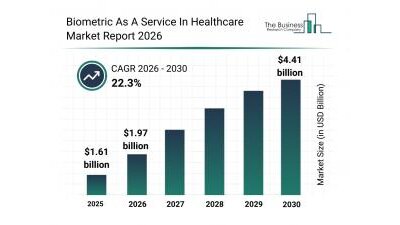
According to the latest data, the biometric as a service in healthcare market has already seen substantial growth. It is projected to climb from $1.61 billion in 2025 to $1.97 billion in 2026, representing a compound annual growth rate (CAGR) of 22.7%. This near-term expansion is fueled by the growing digitization of healthcare records, heightened demand for precise patient identification, the rapid expansion of telehealth, rising concerns over data breaches, and widespread adoption of cloud-based healthcare platforms.
Download a free sample of the biometric as a service in healthcare market report:
https://thebusinessresearchcompany.com/sample_request?id=88907859&type=smp&name=Biometric%20As%20A%20Service%20In%20Healthcare%20Market%20Report%202026&utm_source=EINPresswire&utm_medium=Paid&utm_campaign=Nov_PR
Looking further ahead, the market is expected to maintain strong momentum, reaching $4.41 billion by 2030 with a CAGR of 22.3%. Several forces are driving that long-term growth: an increased need for secure remote healthcare access, growing investments in digital health infrastructure, the rise of AI-powered biometric analytics, stricter regulations on data privacy compliance, and enhanced use of biometric-enabled patient monitoring. Key trends anticipated during the forecast period include broader adoption of cloud-based biometric authentication, more multimodal biometric systems, integration of biometrics into remote patient monitoring, development of secure digital identity platforms, and an intensified focus on protecting healthcare data.
Understanding Biometric as a Service in Healthcare is essential for grasping the market’s trajectory. BaaS in healthcare refers to delivering biometric authentication and monitoring through cloud-based systems. This model enables healthcare providers to securely access, store, and analyze patient biometric information. Its applications include patient identification, remote health monitoring, and access management—all of which boost both security and care quality. BaaS supports accurate, real-time collection of vital health data, such as heart rate and blood pressure, while ensuring compliance with regulations like HIPAA.
View the full biometric as a service in healthcare market report:
https://thebusinessresearchcompany.com/report/biometric-as-a-service-in-healthcare-global-market-report?utm_source=EINPresswire&utm_medium=Paid&utm_campaign=Nov_PR
One of the most powerful forces behind the market’s expansion is the surging use of mobile devices. Smartphones, tablets, and smartwatches facilitate wireless communication and internet access, making healthcare applications more accessible than ever. Advances in wireless technology, the falling cost of smartphones, better internet coverage, and a growing library of mobile health apps have all contributed to this trend. Mobile devices empower BaaS by enabling secure, real-time access to sensitive health information through biometric authentication, combining convenience with regulatory compliance. Ericsson’s November 2024 Mobility Report underscores this shift: global smartphone subscriptions rose from 6.93 billion in 2023 to 7.16 billion in 2024, a clear signal of the mobile-driven demand for biometric services.
Geographically, North America held the largest share of the biometric as a service in healthcare market in 2025. However, the fastest growth during the forecast period is expected to come from the Asia-Pacific region. The market report covers a broad swath of global dynamics, including Asia-Pacific, South East Asia, Western Europe, Eastern Europe, North America, South America, the Middle East, and Africa.
What’s included in our 2026 market reports:
• Market attractiveness scoring and analysis
• Total addressable market (TAM) analysis
• Company scoring matrix graphics and tables
• Excel-based forecasting dashboards
• Market hotspots infographics
• Key technologies and future trend analysis
• Updated graphics and tables
Speak With Our Expert:
Saumya Sahay
Americas +1 310-496-7795
Asia +44 7882 955267 & +91 8897263534
Europe +44 7882 955267
Email: marketing@tbrc.info
The Business Research Company – www.thebusinessresearchcompany.com
Follow Us On:
• LinkedIn: https://in.linkedin.com/company/the-business-research-company“
Oliver Guirdham
The Business Research Company
+44 7882 955267
info@tbrc.info
Visit us on social media:
LinkedIn
Facebook
X
Why it matters: As healthcare becomes more digital and mobile-dependent, biometric authentication is no longer a luxury—it’s a necessity for protecting patient data and enabling remote care. The projected surge to $4.41 billion signals that hospitals, clinics, and telehealth platforms are betting heavily on this technology to meet both security demands and regulatory requirements in an increasingly connected world.