Laboratories are increasingly handing over the delicate work of growing cells to robots and automated systems, and the financial numbers behind that shift are striking. A new market forecast from The Business Research Company shows the automated cell culture equipment sector is poised to more than double in value by the end of the decade, propelled by the rise of personalized medicine and the push for more reproducible research.
The Business Research Company’s Automated Cell Culture Equipment Global Market Report 2026 – Market Size, Trends, And Forecast 2026-2035
The automated cell culture equipment market is undergoing rapid expansion, fueled by breakthroughs in pharmaceutical research and the broader adoption of laboratory automation. With growing demand for consistent, precise cell cultivation, this sector is becoming a linchpin across life science disciplines, from drug discovery to regenerative medicine. Below is a breakdown of market size projections, growth drivers, regional dynamics, and the technological shifts defining this space.
Also worth a look: Behavioral therapy market surges to $240B as mental health demand climbs and BCMA cancer therapy market set to nearly triple by 2030, new report shows.
Market Size and Growth Outlook for the Automated Cell Culture Equipment Market
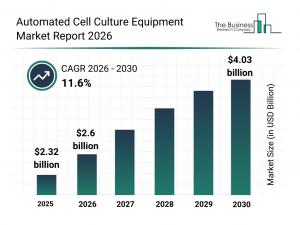
The automated cell culture equipment market has expanded quickly over recent years. Valued at $2.32 billion in 2025, it is expected to climb to $2.6 billion in 2026, reflecting a compound annual growth rate (CAGR) of 11.9%. That historical acceleration traces back to surging demand in pharmaceutical and biologics research, the push for consistent cell culture outcomes, broader drug discovery initiatives, growing complexity in cell-based assays, and early lab adoption of automation tools.
By 2030, the market is forecast to hit $4.03 billion, growing at a CAGR of 11.6%. Looking ahead, the momentum comes from increased funding in regenerative medicine, expanding pipelines for cell and gene therapies, rising need for scalable cell culture options, a heightened emphasis on reducing variability in lab settings, and the integration of AI-powered automation. Emerging trends include the mainstreaming of fully automated cell culture platforms, high-throughput cell processing technologies, robotics and advanced imaging integration, closed-system workflows designed to lower contamination risk, and a sharper focus on process standardization and reproducibility.
Download a free sample of the automated cell culture equipment market report:
https://thebusinessresearchcompany.com/sample_request?id=62879707&type=smp&name=Automated%20Cell%20Culture%20Equipment%20Market%20Report%202026&utm_source=EINPresswire&utm_medium=Paid&utm_campaign=Oct_PR
Understanding Automated Cell Culture Equipment and Its Applications
Automated cell culture equipment refers to advanced laboratory instruments that handle cell growth, maintenance, and monitoring with limited human intervention. These systems pair robotics, sensors, and software to boost reproducibility, efficiency, and precision across cell culture workflows. By taking over repetitive tasks, these tools allow for large-scale experimentation, cut contamination risks, and underpin complex research in drug development, regenerative therapies, and other life science fields.
Primary Market Forces Behind Automated Cell Culture Equipment Expansion
A key engine of growth in this market is the rising adoption of personalized medicine. This approach tailors healthcare to an individual’s genetic profile, lifestyle, and environmental factors, delivering more effective and targeted treatments. Its growing acceptance is tied to better patient outcomes through therapies customized to specific biological characteristics. Automated cell culture technologies support this movement by enabling precise, high-throughput, and highly reproducible cell culture processes essential for patient-specific treatments and tailored drug testing.
For instance, in February 2024, the Personalized Medicine Coalition, a U.S.-based nonprofit, noted that the FDA greenlit 16 novel personalized treatments for rare diseases in 2023—a substantial jump from six approvals in 2022. That leap underscores how personalized medicine’s rise is directly feeding demand for advanced automated cell culture equipment.
View the full automated cell culture equipment market report:
https://thebusinessresearchcompany.com/report/global-automated-cell-culture-equipment-market-report?utm_source=EINPresswire&utm_medium=Paid&utm_campaign=Oct_PR
Regional Outlook Highlighting Asia-Pacific’s Growth Potential in Automated Cell Culture Equipment
North America led the automated cell culture equipment market in 2025, holding the largest share thanks to its sophisticated research infrastructure and early embrace of new technologies. Yet the Asia-Pacific region is slated to become the fastest-growing market in the years ahead. That trajectory is tied to the region’s expanding pharmaceutical and biotech research capabilities, plus rising investment in regenerative medicine and gene therapies.
The report spans multiple regions—Asia-Pacific, South East Asia, Western Europe, Eastern Europe, North America, South America, the Middle East, and Africa—offering a full global view of trends and opportunities in automated cell culture equipment.
The 2026 edition of these market reports now includes enhanced analytical tools such as market attractiveness scoring, total addressable market (TAM) analysis, company scoring matrix graphics and tables, Excel-based forecasting dashboards, market hotspots infographics, key technologies and future trend analysis, plus refreshed graphics and tables.
Speak With Our Expert:
Saumya Sahay
Americas +1 310-496-7795
Asia +44 7882 955267 & +91 8897263534
Europe +44 7882 955267
Email: marketing@tbrc.info
The Business Research Company – www.thebusinessresearchcompany.com
Follow Us On:
• LinkedIn: https://in.linkedin.com/company/the-business-research-company.
Oliver Guirdham
The Business Research Company
+44 7882 955267
info@tbrc.info
Visit us on social media:
LinkedIn
Facebook
X
Why it matters: As personalized medicine moves from promise to practice, the laboratory infrastructure needed to produce patient-specific therapies will only become more critical. The projected doubling of this market signals that automation is no longer a luxury for research labs but a foundational requirement for the next generation of medical breakthroughs.