When a fast-moving wildfire forced a mother to flee her home in Paradise, California, she had only a split second to choose her route—and that choice, made with almost no reliable information, is what saved her life. That harrowing escape, driven by a decision to head toward the mountains, later brought her son, Curt Doty, to Santa Fe with a burning mission: to harness technology so others never have to face such blind gambles.
Ember to Aftermath brings wildfire experts and AI developers together during the inaugural New Mexico Tech Week.
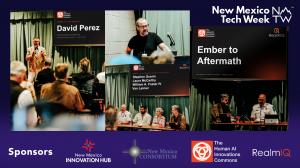
The emotional weight of that day became the catalyst for Ember to Aftermath, an AI hackathon held on October 27 that connected wildfire professionals, entrepreneurs, developers, and community members. Hosted at the New Mexico Innovation Hub as part of the first-ever New Mexico Tech Week, the event—organized by RealmIQ—blended expert talks, open discussion, a coding sprint, and live demonstrations.
Also worth a look: Garage Door Repair Boise posts rare upfront pricing on spring replacements — no charge if you say no and Tony Robbins and Dean Graziosi tackle the AI adoption stall with a new book and live event.
This is a celebration of Human ingenuity and the power of AI used for good.”— Curt Doty
Doty launched the effort with longtime colleague Jeff Boortz, who not only sponsored the hackathon but also designed its core concept, wildfire focus, and overall framework. Boortz, an Emmy-winning creative director and brand strategist, pressed participants to think critically about AI’s potential to expand human invention while never losing sight of skepticism, judgment, and the need for shared economic gains.
Expertise Before Experimentation
The event kicked off with a lineup of seasoned experts. Speakers included New Mexico State Forester Laura McCarthy; William A. Foster IV, Forest Markets Manager for the state Forestry Division; Van Leimer, Wildland Division Chief of the Los Alamos Fire Department; Stephen Guerin, founder of Simtable; and David Perez, founder and CEO of the New Mexico Innovation Hub.
“This was my first experience at an AI Hackathon. The morning presentations by wildfire experts, followed by a question and answer with AI hackers, brought up lots of new ideas. I was curious to learn what the hackers would come up, so I returned to hear their presentations to the judges. It’s a good model to catalyze innovation.” — Laura McCarthy, New Mexico State Forester.
McCarthy addressed the region’s ecological challenges, recovery efforts, and the wisdom embedded in Indigenous land-management practices. Leimer walked attendees through real-world response obstacles and what it takes to be truly prepared. Guerin pitched a “digital acequia”—a community-controlled information-sharing network. Foster laid out the potential for biomass markets to link forest restoration with rural jobs, landowner income, and locally sourced materials and energy.
Three Winning Solutions
Fire Sentry: Dominic Siegele introduced a ground-sensor network that measures smoke particles, gases, and environmental conditions, with a proposed system using cellular communication backed by satellite. His working prototype already recorded rising particle readings near active fires. Developed with the help of Claude, the concept is meant to complement existing cameras and satellites. Next steps include field deployment, hardware testing, false-alarm reduction, and predictive modeling.
FireSpread: Holly Grimm showed off a community camera concept that requires a second viewpoint to confirm smoke detections—a design intended to cut down on false alarms. Local image processing would also limit the transmission of neighborhood footage. The demonstration paired scripted detection alerts with a separate forecast built on historical Hermits Peak data. Integrating those capabilities and validating performance remain priorities.
Ember Ready: Carlos Alvarez and his team demonstrated a mobile-friendly application that combines aerial imagery, homeowner photos, AI analysis, and a preparedness checklist. The prototype flagged vulnerabilities like combustible fencing and vegetation near structures. Built with ChatGPT assistance, it still needs completed scoring, action plans, privacy protections, and expert validation.
Collaboration With Community Purpose
Organizers expressed deep gratitude to the New Mexico Innovation Hub for hosting, singling out David Perez, Kelly Stanhope, the Hub community, the New Mexico Consortium, and participating tenants for their support.
“The New Mexico Innovation Hub is designed to facilitate events like Ember to Aftermath to come together to create,” said Perez. “This project illustrates the important work innovators in New Mexico are doing to make a positive impact on our community at large.”
Thanks also went to New Mexico Tech Week for including Ember to Aftermath in its inaugural program, with special appreciation to Vicki Apodaca and Paul Zelizer.
Judges included Doty, Boortz, Amy McCawley, Carl Mclendon, and an AI judge. All three winning demonstrations were early-stage prototypes that require further development before they can be deployed operationally.
For Doty, the mission never strayed far from the personal: connecting accessible information with the kind of life-or-death decisions his mother had to make. By bringing technical talent together with wildfire expertise, the event turned shared anxiety into practical starting points.
About the Human AI Innovation Commons
The Human AI Innovation Commons is a Georgia nonprofit promoting shared benefits from human–AI invention. Its charter divides net licensing revenue equally among human inventors and contributors, UBI and workforce-transition programs, and an AI Trust Fund supporting third-party AI safety research. Its tools include Brainstorm, Patent Forge, Per Se and Figura.
Curt Doty
RealmIQ
+1 310-994-7810
Visit us on social media:
LinkedIn
Why it matters: This hackathon shows how a deeply personal story can mobilize technical talent around a critical public-safety challenge. While the three prototypes are still early-stage, the event itself created a replicable model for pairing AI developers with domain experts—potentially accelerating tools that could give communities more time to make life-saving decisions in the face of increasingly frequent wildfires.