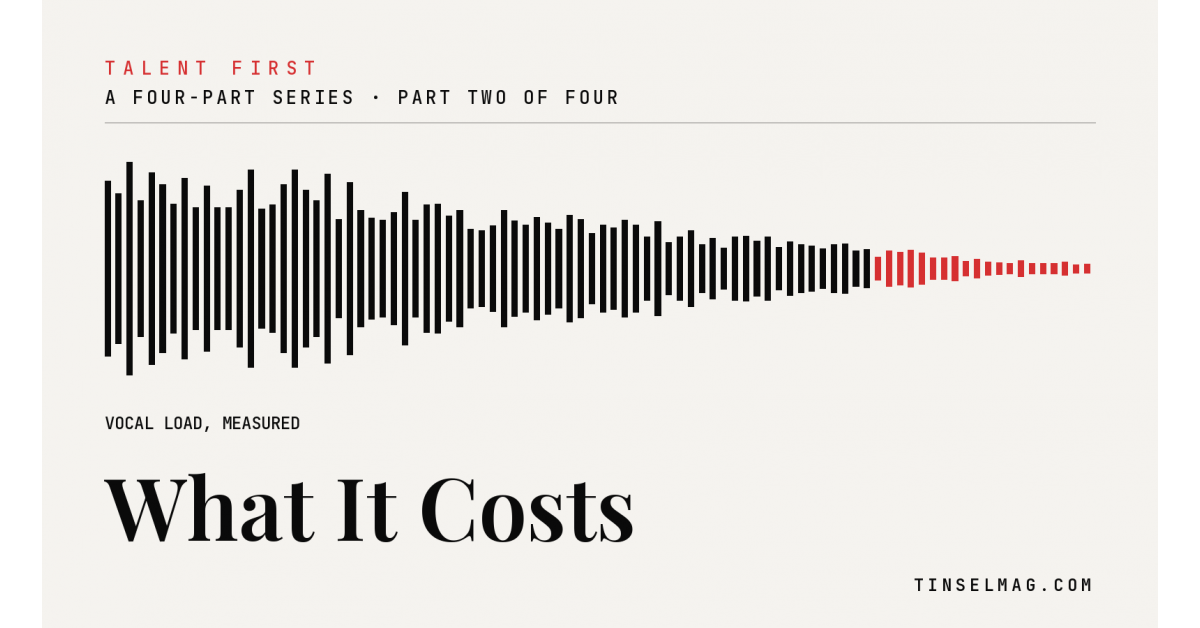
Second Edition Explores Voice Medicine, Data on Recovery, and Burnout Studies Behind the Live Economy’s Extended Broadcast Schedules
When a workplace makes employees afraid to take breaks and management responds with a number instead of a timetable, that workplace has revealed what it truly values.”— Tinsel Magazine
Tinsel Magazine has released “What It Costs,” the second part of “Talent First,” its four-part examination of the economics surrounding live performance, which debuted on the same date as the series’ first entry, “The Grind Economy.” The publication states that this installment treats performer health as an occupational issue, analyzing the live-streaming industry through the lens of what voice medicine and burnout studies have already documented. The third and fourth parts will be published on August 19.
The piece begins with the physical mechanics of the voice. Drawing on research from the National Center for Voice and Speech led by Ingo Titze, Tinsel Magazine notes that scientists compute a speaker’s “vocal dose” by measuring the total distance the vocal folds travel during vibration, and they established a safe working threshold of roughly 500 meters of tissue movement—equivalent to about seventeen minutes of uninterrupted speaking. The article describes this number as “a modeling benchmark rather than a hard clinical limit.”
Next, the article turns to findings on vocal recovery. Citing a study published in the Annals of Otology, Rhinology & Laryngology, it reports that after two hours of continuous vocal use, the voice recovered about 90 percent within four to six hours but required twelve to eighteen hours for full restoration—a pattern the researchers likened to the healing timeline of a skin wound. As the article puts it, a performer streaming six hours daily is “in tissue terms, reopening a wound that never finished closing.”
The article examines the body of research on occupational voice disorders: a foundational study involving over 2,500 adults found that 11 percent of teachers currently had a voice problem, compared to 6.2 percent of the general population, and a meta-analysis of eleven studies estimated that 46 percent of singers self-report voice disorders, whereas the lifetime rate in the general population is under 30 percent. According to the publication, the live economy “asks for more hours with less structure and, for most of its performers, no training at all.”
The publication documents the consequences at the upper echelons of traditional music, citing clinical protocols from the University of Iowa on vocal fold hemorrhage and public incidents reported by CBS News and other outlets: Adele’s canceled 2011 U.S. tour dates and roughly two months of voice rest after surgery, Sam Smith’s abandoned Australian tour in 2015, Meghan Trainor’s two vocal cord hemorrhages that same year, and Björk’s polyp surgery. “In every case, the show stopped,” the article observes, because “the system around a star is built to protect the asset.”
The article contrasts that protective framework with the emerging record of the live economy, reporting that two of Japan’s most popular streaming performers have been sidelined by diagnosed vocal cord nodules, as covered by Dexerto and Siliconera. The publication notes that no prevalence study of livestreamers’ voices has been published yet, and it cites the closest peer-reviewed measurements: a 2026 study in BMC Sports Science, Medicine and Rehabilitation found that one in five esports players had a clinically screenable voice problem, and a union survey of video game voice actors revealed that 43 percent needed two or more days for their voice to return to normal after a session.
On the mental-health front, the article references the Guardian’s coverage of the 2018 YouTube burnout wave, NPR’s 2022 reporting on Twitch streamers describing “anxiety bordering on panic attacks,” and industry surveys indicating burnout among 78 to 90 percent of creators polled—figures the article carefully notes come from samples that are “small and self-selected, run by companies with products to sell.”
The publication also examines the continuous workload unique to live performance, drawing on experimental research about parasocial interaction and communication scholarship on what researchers term “relational labor”—the effort of maintaining thousands of one-sided intimacies with viewers. One of the article’s most pointed observations reads: “the product decays on the same curve as the performer: the sixth hour of any voice is a worse show than the first, so a format that pays for endurance is quietly optimizing away the performances it sells.”
The piece concludes with what it calls the most cruel irony—that rest itself is seen as a risk. It cites a Cornell-led study where creators described burnout as something they shared with researchers but concealed from audiences, notes YouTube’s 2019 data-based reassurance to creators, and quotes Twitch’s chief executive acknowledging in 2025 that streamers who want to change their approach feel unable to, “because your viewership will go down.” The publication ends: “Other industries counted these costs decades ago and built scaffolding around their performers to carry them. This one externalizes the costs onto the performer and calls the result independence.”
The full installment is available now at https://tinselmag.com/talent-first-part-two/. Part One, “The Grind Economy,” is available at https://tinselmag.com/talent-first-part-one/. Parts Three and Four follow on August 19.
—
Sources:
– Titze, Svec & Popolo, ["Vocal Dose Measures," Journal of Speech, Language, and Hearing Research, 2003](https://pubmed.ncbi.nlm.nih.gov/12959470/)
– Hunter & Titze, ["Quantifying Vocal Fatigue Recovery," Annals of Otology, Rhinology & Laryngology, 2009](https://pubmed.ncbi.nlm.nih.gov/19663377/)
– Roy et al., ["Prevalence of Voice Disorders in Teachers and the General Population," JSLHR, 2004](https://pubmed.ncbi.nlm.nih.gov/15157130/)
– Pestana, Vaz-Freitas & Manso, ["Prevalence of Voice Disorders in Singers: Systematic Review and Meta-Analysis," Journal of Voice, 2017](https://pubmed.ncbi.nlm.nih.gov/28342677/)
– University of Iowa Head and Neck Protocols, ["Vocal Fold Hemorrhage"](https://iowaprotocols.medicine.uiowa.edu/protocols/vocal-fold-hemorrhage-vocal-cord-bleed-vocal-varix-telangiectasia)
– CBS News on [Adele (2012)](https://www.cbsnews.com/news/meet-adeles-vocal-cord-surgeon-dr-steven-zeitels/), [Sam Smith (2015)](https://www.cbsnews.com/news/sam-smith-says-he-needs-surgery/), and [Meghan Trainor (2015)](https://www.cbsnews.com/news/meghan-trainor-cancels-tour-will-get-surgery-on-vocal-cord/)
– Dexerto on [Usada Pekora's hiatus, 2022](https://www.dexerto.com/entertainment/hololive-usada-pekora-hiatus-fix-health-issues-1824142/); Siliconera on [La+ Darknesss, 2024](https://www.siliconera.com/hololive-vtuber-la-darknesss-on-hiatus-for-health-reasons/)
– Birol et al., ["Prevalence of voice problems and associated risk factors in electronic sports players," BMC Sports Science, Medicine and Rehabilitation, 2026](https://pmc.ncbi.nlm.nih.gov/articles/PMC12910755/)
– Canadian Occupational Safety, [ACTRA video game voiceover survey (conducted 2021, reported 2022)](https://www.thesafetymag.com/ca/topics/safety-and-ppe/vocal-stress-prevalent-among-actors-in-video-game-voiceover-field-report/416218)
– The Guardian, ["The YouTube stars heading for burnout," 2018](https://www.theguardian.com/technology/2018/sep/08/youtube-stars-burnout-fun-bleak-stressed)
– NPR, ["Burnout turned Twitch streamers' dreams… into nightmares," 2022](https://www.npr.org/2022/08/16/1117650184/twitch-streamers-burnout-video-games)
– Tubefilter, [on the Vibely creator burnout survey, November 2021](https://www.tubefilter.com/2021/11/11/vibely-content-creators-burnout-study/); Awin, ["78% of influencers admit to suffering burnout," August 2022](https://www.awin.com/us/news-and-events/industry-news/creator-burnout-survey)
– Wulf, Schneider & Queck, [Cyberpsychology, Behavior, and Social Networking, 2021](https://www.liebertpub.com/doi/full/10.1089/cyber.2020.0546)
– Baym, [Playing to the Crowd, NYU Press, 2018](https://nyupress.org/9781479821587/playing-to-the-crowd/)
– Cornell Chronicle, [on Nguyen & Duffy, New Media & Society, July 2026](https://news.cornell.edu/stories/2026/07/what-social-media-creators-cant-say-about-their-job)
– YouTube Official Blog, [Susan Wojcicki's letter to creators, November 2019](https://blog.youtube/inside-youtube/my-final-letter-in-2019/)
– The Game Business, [interview with Twitch CEO Dan Clancy, June 2025](https://www.thegamebusiness.com/p/i-asked-the-twitch-ceo-are-you-profitable)
—
About Moxie Media Marketing
Moxie Media Marketing is a media and talent company led by chief executive Kenneth W. Welch Jr. The company represents and develops independent creators and performers, with a focus on career longevity, professional oversight, and sustainable working standards across live and digital platforms. Drawing on its two-year review of how live-platform ecosystems treat the talent operating inside them, Moxie originated the questions behind the "Talent First" series.
—-
About Tinsel Magazine
Tinsel Magazine is a digital culture publication covering entertainment, style, internet culture, and the people shaping contemporary life. Based in Los Angeles, Tinsel publishes original editorial with a focus on the creative figures, cultural movements, and industry shifts that define modern media. The magazine's Tinsel Exclusive series profiles creators, artists, and cultural figures whose work is redefining their respective fields. For more information, visit https://tinselmag.com/.
Broc Foerster
Moxie Media Marketing, Inc.
email us here
Visit us on social media:
YouTube