
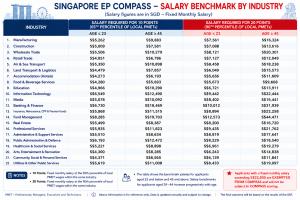
A detailed overview of the EP COMPASS salary benchmarks across 22 industry sectors in Singapore.
For global professionals moving to Singapore, obtaining an Employment Pass (EP) typically represents the first milestone. After that, questions about bringing family members—such as spouses, children’s education, and parents’ relocation—become key priorities for applicants.
A well-designed EP application strategy should include family needs from the very beginning. Globevisa Group, an immigration and relocation consultancy based in Singapore, points out that the primary applicant’s salary level and EP status directly influence whether their family members can obtain legal residency in the country.
How EP Applications Relate to Family Relocation
The Singapore EP is a work permit aimed at foreign professionals, managers, and executives. Applications are usually submitted by a company registered in Singapore. Entrepreneurs who want to start a business locally can also apply for an EP by forming a company and hiring themselves in a managerial role.
Regardless of the application route, the applicant must hold a genuine management position, and the company must show that it has operational capacity and the financial means to pay the stated salary. Globevisa Group’s local team advises that professionals planning to bring family members should set the appropriate salary level during the company setup phase to ensure future dependant visa approvals. It is recommended to have a comprehensive plan covering the initial application, business operations, and subsequent visa renewals.
Understanding Salary Thresholds: The COMPASS Framework and Risk Management
Currently, the minimum fixed monthly salary for an EP applicant is SGD 5,600 (SGD 6,200 for the financial services sector), with higher requirements based on age and work experience. Additionally, applicants must score at least 40 points on the Ministry of Manpower’s (MOM) COMPASS evaluation system.
Under the COMPASS framework, having a degree or past management experience is not mandatory. Key scoring criteria include the applicant’s fixed monthly salary, educational or professional qualifications, the company’s nationality diversity, and support for local employment. If maximum points cannot be achieved through education, the salary level becomes a decisive factor. Salary points are awarded based on the applicant’s percentile rank compared to other local professionals (individuals working in Singapore) in the same sector and age group, not just the absolute salary amount.
Example Calculation (Based on 2026 Salary Benchmarks):
For an applicant aged 45 or older in the traditional wholesale trade sector:
●A fixed monthly salary of approximately SGD 10,279 may yield 10 salary points.
●A fixed monthly salary of approximately SGD 20,301 may yield 20 salary points.
(Note: Benchmarks are updated periodically; a pre-assessment is required before applying.)
In complex situations—such as older applicants, those without formal degrees, or companies applying for multiple EPs—early assessment is essential. For instance, Globevisa Group uses the MOM’s official Self-Assessment Tool (SAT) before submission to confirm that application materials comply with current regulations and to reduce the risk of rejection due to information mismatches.
Dependant Visa Types and Corresponding Salary Requirements
The main applicant’s salary determines both EP approval and eligibility for family residency passes. The requirements for each dependant category are as follows:
Dependant’s Pass (DP)
●Eligibility: Legally married spouse and unmarried children under 21 years old of the EP holder.
●Core Requirement: The main applicant must earn a minimum fixed monthly salary of SGD 6,000. This threshold is based solely on the main applicant’s personal salary and does not include combined household income.
●Policy Details: The DP’s validity is directly tied to the main applicant’s EP status. If the EP expires or is cancelled, the DP is also invalidated. Spouses holding a DP who wish to work in Singapore generally need their employer to apply for an appropriate work pass.
Long-Term Visit Pass (LTVP)
●Eligibility: Parents of the EP holder.
●Core Requirement: The main applicant must earn a fixed monthly salary exceeding SGD 12,000.
●Policy Details: To sponsor parents for long-term residency, this higher salary threshold must be met; otherwise, the LTVP application via the EP route is not allowed.
In practice, an assessment of family relocation needs is carried out before the EP submission. If the initial salary does not meet the requirements, adjustments can be made through a phased compliance approach. For example, once the company has substantive operations and meets financial conditions, the main applicant can submit a formal salary increase request to MOM with supporting documents. Once the salary adjustment is approved and meets the threshold, subsequent DP or LTVP applications can be submitted.
Vaccination Requirements and Education Guidelines for Children
For families with young children, visa applications and educational planning should be coordinated. Under Ministry of Health regulations, foreign-born children aged 12 and under applying for a DP must submit a Verification of Vaccination Requirements issued by relevant authorities. This mainly covers mandatory vaccines such as MMR (Measles, Mumps, Rubella) and DTaP (Diphtheria, Tetanus, Pertussis). Incomplete records will delay DP issuance; therefore, families are advised to complete the notarization and verification of medical documents before submission.
Regarding education, once a child is officially admitted to a local school in Singapore, holding a DP generally eliminates the need for a separate Student’s Pass. Enrollment can be processed directly with the DP. This mechanism reduces uncertainties related to Student’s Pass quota limitations at certain educational institutions.
Conclusion
Relocating a family internationally is a systematic process involving career development, tax planning, and long-term regulatory compliance. As international immigration regulations become stricter, traditional single-service visa processing is often insufficient for the needs of globalized families.
Headquartered in Singapore and operating in the immigration sector for over two decades, Globevisa Group currently maintains more than 50 direct branches globally with over 800 in-house employees. The firm has handled over 120,000 cases for clients from more than 120 countries and regions.
The value of an established relocation planning system lies in providing institutional-level risk management and legal compliance. From initial eligibility assessments to post-arrival tax declarations and integration guidance, professional support teams provide the foundation for international talent to establish a stable presence in Singapore.
About Globevisa Group
Established in 2002 in Singapore, Globevisa Group is a premier wealth management and cross-border identity advisor for HNWIs. With 50+ global branches and 800+ in-house experts, the firm ensures institutional-grade risk control. Globevisa has successfully delivered citizenship, residency, and relocation solutions to 120,000+ clients across 120+ countries, ensuring barrier-free global mobility.
Globevisa Group Team
Globevisa Group
email us here
Visit us on social media:
LinkedIn
Instagram
Facebook
YouTube
TikTok
X