Log-hub has rolled out custom map hierarchies and a stochastic mode within the Inventory Simulation App as part of its Log-hub 6.4 release.
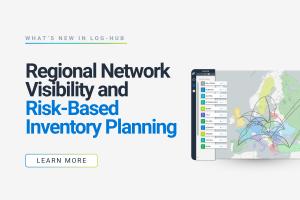
This upgrade allows supply chain teams to view their networks based on their own geographic divisions and test inventory policies under a variety of demand scenarios, enabling more informed, data-backed choices.
Supply chains are commonly run by regions or different geographical units, but network maps rarely reflect how they actually function. Inventory planning faces a comparable challenge, since demand fluctuates daily while policies are often based on a single static forecast. In both situations, teams end up redoing the analysis in spreadsheets before it can be used for management decisions, and Log-hub 6.4 aims to eliminate that extra step.
Through the new custom map hierarchies, organizations can establish their own regions and see their network in that exact structure, from individual sites up to country-to-country, region-to-region, or even continent-to-continent flows. The resulting view turns thousands of shipment links into a clear network overview, ready for management reviews or board presentations. It brings attention to major transport corridors, regional dependencies, and chances to consolidate lanes or cut out unneeded movements between regions.
The new stochastic approach in the Inventory Simulation App helps businesses make better inventory choices by running multiple demand scenarios and assessing different replenishment policies for every SKU and time period. By measuring the effect on service levels, lost sales, and costs, the app allows supply chain teams to spot risks, weigh trade-offs, and set data-supported inventory targets. This lets teams identify SKUs at risk of stockouts or excess inventory before issues arise, while giving executives clear policy alternatives and their related trade-offs to support a structured, risk-based approach to working capital management.
Alexander Sigmund, CTO of Log-hub, stated: “Supply chain leaders are measured on cost, service, and working capital, and Log-hub 6.4 is designed to improve all three. Our customers can now see where their network is losing money and back their inventory targets with proof, early enough to act before it shows up in the numbers.”
Other enhancements in Log-hub 6.4 cut down manual work between data and decision in a similar way. In the Milkrun and Transport Optimization apps, multiple orders delivered to the same location now count as a single stop, so teams no longer have to merge orders or adjust stop limits as a workaround.
The Supply Chain Apps Agent can now produce interactive charts directly from app output tables and examine datasets with over 100,000 rows by working on the underlying data.
Log-hub 6.4 brings supply chain analysis closer to how organizations are structured and how demand behaves in practice. Updates like this come every two months, and teams already using Log-hub’s Supply Chain Apps receive every new feature at no extra cost, so the tools they use keep improving with each release.
To see the new features in action, watch the Log-hub 6.4 release webinar or test it yourself by getting our Fremium plan.
Jan Sigmund
Log-hub AG
email us here
Visit us on social media:
LinkedIn
YouTube
X
Beat US Tariff Changes: Building a Tariff Evaluation Engine