For a local HVAC contractor or plumbing company, knowing your own revenue is only half the battle — the other half is knowing who’s circling the same customers. That’s the gap Home Service Base is targeting with its newly relaunched platform, which shifts from a static directory to a live market intelligence tool for the trades.
The platform maps local competitors, tracks Google Maps and AI visibility, and alerts home service owners to new locations and advertising changes.
You know how your business is doing. But do you know what's happening around it?”— Dmytro Perepelytsia, founder of Home Service Base
COLUMBUS, OH, UNITED STATES, October 12, 2026 /EINPresswire.com/ — Home Service Base, a market intelligence platform for home service businesses, has relaunched as a market-first research tool for owners, agencies and investors in trades such as HVAC, plumbing, roofing, appliance repair and pest control. Instead of starting from a single website or Google Business Profile, the platform starts from the market: a user picks an industry and an area by county, city or ZIP code and sees every competitor operating there.
The original iteration of Home Service Base was essentially a static database, used mostly by software vendors hunting for prospect lists. That’s changed. The updated version pulls data on demand for each saved market, meaning coverage extends to any US area and any service industry, with pricing aimed at small business owners rather than enterprise budgets.
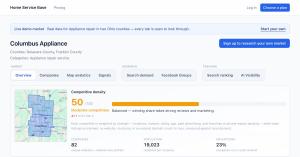
Each saved market becomes a single report. It assigns a competitive density score from 0 to 100, reveals which competitors are buying ads on Google Ads, Local Services Ads, Meta and Bing, shows how many reviews are needed to stay competitive, flags which companies are franchises or private equity-backed, and layers in census data like households, home values and income. The report also surfaces winnable gaps — for instance, the percentage of competitors lacking an online booking button, a website or a claimed profile.
New to this relaunch is tracking across the three main places customers discover local service companies. On Google Maps, the Map Rank tracker checks a business's position at every point of a street-level grid on a schedule and produces share links and PDF reports. In Google Search, Search ranking checks keywords across every city in a market. In AI answers, AI Visibility asks ChatGPT and Google AI Overviews the questions customers ask, such as "best", "near me", "cost" and "emergency", and reports which companies the answers recommend and which sources they cite.
For planning, Search demand shows monthly Google search volume and cost per click by county with 12 months of history. Map analytics colors an area by competition, population or income by ZIP code or a custom hexagon grid, and Compare puts up to four markets side by side. Signals email users when a competitor opens a new Google Business Profile, starts or stops advertising, or switches software.
Background workers collect the data around the clock from Google Maps, company websites, ad libraries, search results, domain records and US Census data. The database covers more than 1.7 million home service companies, 4.6 million Google Business Profiles and 1,300 software products detected on company websites. Users can also browse databases of software, franchise brands and private equity firms, use a Chrome extension, export CSV files, and connect the data to AI assistants such as Claude through a REST API and an MCP server.
"You know how your business is doing. But do you know what's happening around it?" said Dmytro Perepelytsia, founder of Home Service Base. "I run an appliance repair company with 11 Google Business Profiles across several metros. The decisions that cost the most were made without seeing the market: where to open the next location, which keywords to pay for, who just started advertising next door. The new Home Service Base is built for the owner who makes those decisions every week."
Perepelytsia, a software engineer, built the platform alongside his own home service company. A Signal on his market caught a competitor launching a Google Business Profile in Columbus, Ohio, before his company had opened there.
Home Service Base is available now. Plans start at $39 per month, with Business at $99, Corporate at $399 for agencies with three seats, and Enterprise for large agencies that need white-label reports. New accounts start with a three-day trial that needs no credit card. A complete sample report, covering appliance repair in Franklin and Delaware counties in Ohio, is open without an account at homeservicebase.com/demo.
About Home Service Base
Home Service Base is a market intelligence and competitor analysis platform for home service businesses, marketing agencies, software vendors, franchises and private equity firms. It maps every competitor in a US county, city or ZIP code, tracks Google Maps, search and AI-answer visibility, and alerts users when competitors open locations, start advertising or change software. The company is based in Columbus, Ohio. Learn more at https://homeservicebase.com.
Why it matters: As customer discovery shifts from yellow pages to AI chat assistants and map rankings, local service businesses without a clear view of their competitive landscape are flying blind. Tools like this turn scattered signals — a new Google profile, a sudden ad buy, an unclaimed listing — into actionable intelligence, giving smaller operators a fighting chance against bigger, better-funded rivals.
Dmytro Perepelytsia
Home Service Base
dmytro@homeservicebase.com
Visit us on social media:
LinkedIn
Facebook
X