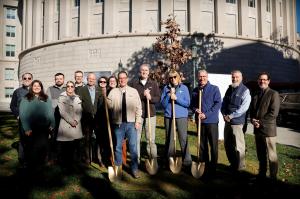
A red oak now stands on the grounds of the Pennsylvania State Capitol Complex, a living marker of a massive environmental push that is already reshaping the Great Lakes region. The tree, planted today by Governor Josh Shapiro alongside state officials, represents more than a ceremonial gesture — it is a symbol of progress toward a goal that once seemed audacious.
GSGP Great Lakes Trees Initiative logo
Effort is part of GSGP's Great Lakes Trees Initiative
Also worth a look: Comfort Keepers of Roswell warns families: hiring a private caregiver carries hidden risks and Comfort Keepers offers Portage families a roadmap for dementia care decisions.
Governor Shapiro, who chairs the Great Lakes St. Lawrence Governors & Premiers (GSGP), joined Pennsylvania Department of Conservation and Natural Resources Secretary Cindy Adams Dunn and Department of Agriculture Secretary Russell Redding for the planting. The event highlighted the strides made under the Great Lakes Trees Initiative, which aims to put 250 million trees in the ground across the region by 2033.
Since the initiative launched in 2023, participating states and provinces, working alongside a network of partners, have planted more than 57 million trees. The pace is accelerating: in 2025 alone, over 30 million trees were planted across the region. Pennsylvania has contributed more than 5.4 million trees toward its own commitment of 34 million as part of the broader regional target.
“Three years ago, the Great Lakes St. Lawrence Governors & Premiers set an ambitious goal, and so far, we have planted more than 57 million trees in just two years,” said Governor Shapiro. “That’s what this organization is all about — getting stuff done together for the people we serve. It is our shared responsibility to protect our vital natural resources, and we are going to continue to work together to protect the Great Lakes for generations to come.”
The GSGP is coordinating with state and provincial governments, federal agencies, Indigenous communities, private companies, foundations, and other institutions to reach the 250 million tree target by 2033. The scope of the collaboration reflects the scale of the challenge — and the ambition of the plan.
The benefits of these plantings extend well beyond the simple act of putting trees in the soil. According to the initiative, the trees deliver a range of environmental, economic, and social returns:
• Cleaning the air by storing carbon and removing pollutants
• Supporting physical and mental health
• Reducing urban heat effects
• Capturing stormwater and helping protect streams, lakes, and drinking water
• Providing habitat for wildlife and plants
• Creating recreational opportunities, economic benefits, and jobs.
Why it matters: With more than 57 million trees already planted and the 2033 deadline still years away, the initiative is building momentum that could reshape the region’s landscape and economy. The effort shows what cross-border cooperation on natural resources can achieve — and sets a benchmark for large-scale environmental restoration that other regions may look to follow.
Craig Clark
Clark Communications
+1 616-550-2736