For patients and healthcare systems grappling with the high cost of biologic drugs, a new wave of affordable alternatives is on the horizon. The market for biosimilar lymphocyte modulators—treatments that replicate complex biologic therapies for autoimmune diseases and cancer—is not just growing; it is accelerating at a pace that signals a fundamental shift in treatment access.

The Business Research Company’s Biosimilar Lymphocyte Modulator Global Market Report 2026 – Market Size, Trends, And Forecast 2026-2035
Interest in the biosimilar lymphocyte modulator space is intensifying, driven by progress in therapies for autoimmune conditions and cancer. As healthcare systems confront rising costs and expanding patient populations, the evolution of treatment options is pushing this market toward significant expansion. A closer look at the current valuation, the factors fueling growth, regional leadership, and emerging trends reveals a sector in rapid transformation.
Steady Growth Expected in the Biosimilar Lymphocyte Modulator Market Size
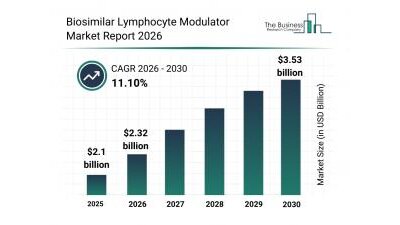
The sector has already posted strong recent gains. According to new data, the market is forecast to climb from $2.1 billion in 2025 to $2.32 billion in 2026, a compound annual growth rate (CAGR) of 10.6%. That momentum, analysts say, has been built on the high price of branded biologics, a rising tide of autoimmune disease diagnoses, climbing cancer rates, limited patient access to novel therapies, and a global increase in healthcare expenditure.
Access a free sample of the biosimilar lymphocyte modulator market report:
https://thebusinessresearchcompany.com/sample_request?id=72289949&type=smp&name=Biosimilar%20Lymphocyte%20Modulator%20Market%20Report%202026&utm_source=EINPresswire&utm_medium=Paid&utm_campaign=Nov_PR
Looking further out, the pace is expected to pick up even more. By 2030, the market is projected to reach $3.53 billion, representing a CAGR of 11.1% over the forecast period. Several catalysts are driving this surge: the expiration of patents on reference biologics, a swelling pipeline of new biosimilar candidates, growing physician confidence in these treatments, the rise of online pharmacy distribution, and stronger government policies encouraging biosimilar adoption. Key trends include a shift toward biosimilar lymphocyte modulators as cost-effective options, heightened demand for therapies targeting autoimmune disorders and cancer, broader clinical acceptance of biosimilars in clinical settings, expanded treatment choices for diseases like multiple sclerosis and multiple myeloma, and increasingly streamlined regulatory pathways.
Defining Biosimilar Lymphocyte Modulators and Their Role
These agents are designed to closely mimic original biologic drugs, acting as immune-regulating therapies. They help manage cancer and autoimmune diseases by modulating the body’s immune response. They also play a role in regulating carotene intake for individuals with compromised immune systems, positioning them as a critical tool for restoring immune balance.
View the full biosimilar lymphocyte modulator market report:
https://thebusinessresearchcompany.com/report/biosimilar-lymphocytes-modulator-global-market-report?utm_source=EINPresswire&utm_medium=Paid&utm_campaign=Nov_PR
How Autoimmune Disease Trends Support Market Expansion
A primary engine of growth is the rising prevalence of autoimmune diseases, where the immune system mistakenly attacks healthy tissue. Environmental triggers—including pollution and chemical exposures—are increasingly linked to this dysregulation, fueling abnormal immune responses. Biosimilar lymphocyte modulators work by adjusting immune activity to reduce symptoms and inflammation. To illustrate the scale of the need, Arthritis Australia, a non-profit, projects that in 2025, roughly 212,136 men and 362,137 women in Australia will be living with rheumatoid arthritis. Those numbers are expected to climb to about 280,040 men and 479,828 women by 2040, highlighting the growing therapeutic demand these drugs are designed to meet.
Regional Overview of the Biosimilar Lymphocyte Modulator Market
North America commanded the largest market share in 2025, but the Middle East is forecast to be the fastest-growing region through the forecast period. The report also covers Asia-Pacific, South East Asia, Western Europe, Eastern Europe, South America, and Africa, offering a comprehensive global view of market dynamics and opportunity.
The 2026 edition of the market report now includes expanded strategic intelligence: market attractiveness scoring and analysis, total addressable market (TAM) assessment, company scoring matrix graphics and tables, Excel-based dashboards, market hotspots infographics, key technology and future trend analysis, plus updated graphics and tables.
Speak With Our Expert:
Saumya Sahay
Americas +1 310-496-7795
Asia +44 7882 955267 & +91 8897263534
Europe +44 7882 955267
Email: marketing@tbrc.info
The Business Research Company – www.thebusinessresearchcompany.com
Follow Us On:
• LinkedIn: https://in.linkedin.com/company/the-business-research-company“
Oliver Guirdham
The Business Research Company
+44 7882 955267
info@tbrc.info
Visit us on social media:
LinkedIn
Facebook
X
Why it matters: As patent protections for expensive biologic drugs expire and autoimmune disease rates climb worldwide, biosimilar lymphocyte modulators represent a rare convergence of cost savings and expanded patient access. For healthcare systems already stretched thin, this market’s acceleration signals that affordable, effective alternatives to blockbuster biologics are no longer a future prospect—they are arriving now.