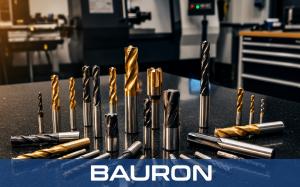
In precision machining, the gap between what a standard tool can do and what a job actually requires is often where costly compromises creep in. Bauron, a specialist in precision cutting tools, is now closing that gap by combining micron-level manufacturing tolerances with a digital design platform that lets manufacturers define their own tool geometry from the start.
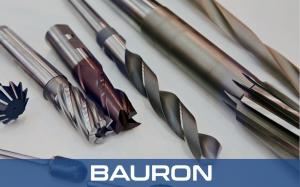
Precision CNC tooling manufacturer showcases ±0.0025 mm tolerances, 5-axis grinding, and online custom tool design.
Precision is not just about tighter tolerances. It is about engineering the right cutting tool for every application.”— Mucahit Basaran, CEO
Bauron, a specialist in precision cutting tools and CNC machining tools, is highlighting its advanced custom tooling capabilities, including manufacturing tolerances down to ±0.0025 mm (±0.0001 in) (2.5 microns) on selected critical tool features. Combining 5-axis CNC grinding, precision metrology, and digital tool design services, Bauron enables manufacturers to specify cutting tools engineered for demanding machining applications.
The company’s manufacturing capabilities address a fundamental challenge in precision machining: standard cutting tools cannot always satisfy complex geometries, non-standard dimensions, or application-specific performance requirements. When a standard catalog item falls short, the alternative has often been to adapt the process around the tool — a workaround that can cost time, accuracy, and consistency.
2.5-Micron Precision: Engineering Beyond Standard CNC Tooling
At the center of Bauron’s manufacturing capabilities is advanced 5-axis CNC tool grinding, supporting precision tolerances down to ±0.0025 mm on selected critical diameters, step transitions, and corner radii. This level of dimensional control is particularly relevant for manufacturers requiring specialized tool geometries and repeatable machining performance — especially in industries where even slight deviations can compromise part quality.
Bauron’s engineering capabilities include:
– Precision tolerances: Down to ±0.0025 mm on qualifying critical tool features.
– Advanced manufacturing: 5-axis CNC tool grinding with in-process measurement.
– Tool materials: Solid carbide, high-speed steel, and HSS-Co options.
– Tool geometries: Custom diameters, flute configurations, cutting lengths, corner radii, and specialized profiles.
– Surface engineering: Application-specific coating options, including AlTiN, TiAlN, and DLC.
– Quality verification: Optical inspection, coordinate measuring machines (CMM), and dimensional inspection documentation.
Achievable tolerances depend on tool geometry, material, and manufacturing requirements and are confirmed during engineering review. This means the advertised precision is not a blanket guarantee but a capability that is validated on a case-by-case basis before a quote is issued.
From a Single Prototype to Industrial Production
Bauron supports custom CNC tool manufacturing without a fixed minimum order quantity, accommodating single-piece prototypes as well as larger production programs. This flexibility is significant for manufacturers who need to test a new tool design before committing to volume — or who only need a handful of specialized tools for a niche operation.
As an end mill manufacturer, Bauron provides square end mills, ball nose cutters, corner radius end mills, and specialized milling geometries. Its portfolio also includes custom drill bits, precision reaming tools, custom taps, and CNC threading tools engineered for specific materials and machining conditions.
For drilling and reaming applications, engineers can evaluate non-standard diameters, specialized cutting-edge geometries, hole-finishing requirements, and tool stability. Rather than relying exclusively on catalog specifications, Bauron develops tooling around the machining operation — treating each tool as an engineered solution rather than an off-the-shelf product.
Digital CNC Tool Design Meets Precision Manufacturing
Through its Custom CNC Tool Design platform, Bauron allows manufacturers to submit application-specific requirements for mills, drills, taps, and reamers. Customers can define dimensions, cutting geometry, material requirements, coating preferences, and other specifications through dedicated digital design forms. Interactive 3D product visualization is also available for selected tools, supporting visual inspection of tool geometry before any metal is cut.
Submitted designs are reviewed by Bauron’s engineering team for manufacturability, material suitability, and production requirements before quotation. This approach connects digital specification with practical engineering and manufacturing expertise — so the customer gets not just a tool, but a validation of whether their design will perform as intended.
Engineering Precision Around Real Manufacturing Challenges
“Manufacturers should not have to compromise their machining processes simply because a standard cutting tool cannot meet their requirements,” says Mucahit Basaran, CEO at Bauron.
“Precision is not just about achieving a smaller tolerance. It is about engineering the right geometry, material, and cutting characteristics for the application. By combining micron-level manufacturing capabilities with custom digital tool design, we give manufacturers greater control over their tooling requirements.”
Bauron’s engineering approach considers tool geometry, cutting parameters, workpiece material, chip evacuation, coating selection, and dimensional accuracy together. The company supports precision machining requirements across automotive, aerospace, electronics, energy, and general industrial manufacturing — sectors where tool performance directly impacts throughput, surface finish, and part consistency.
Bauron — Ultra Precision. High Performance.
Bauron specializes in precision CNC cutting tools, custom tool manufacturing, and application-specific engineering. Its portfolio includes end mills, drills, taps, reamers, and specialized cutting tools. Bauron draws on engineering and manufacturing expertise associated with Norck and Baucor, supporting custom tooling development and industrial manufacturing applications.
Rabia KOCA
Norck
Visit us on social media:
LinkedIn
Why it matters: As manufacturing demands grow more complex, the ability to specify and receive custom tooling at micron-level precision — without minimum order barriers — gives shops a practical path to optimize processes instead of adapting to standard tool limitations. For industries like aerospace and energy, where tolerances and repeatability are non-negotiable, this kind of capability could shift how tooling is specified and sourced.