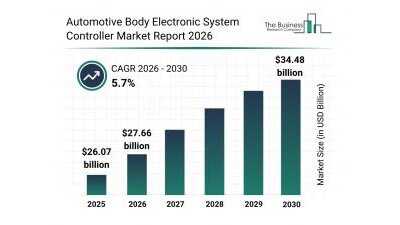
The global automotive body electronic system controller market is accelerating faster than the cars it helps run, with new data showing a climb from $26.07 billion in 2025 to an expected $27.66 billion this year. That 6.1% compound annual growth rate signals just how central these systems have become to modern vehicles — and how much further the industry still has to go.

The Business Research Company’s Automotive Body Electronic System Global Market Report 2026 – Market Size, Trends, And Forecast 2026-2035
Recent expansion in the automotive body electronic system controller market reflects how deeply electronics now permeate vehicle design. Consumers want more comfort and convenience, automakers are packing more electronic content into each model, and centralized control architectures are replacing older, fragmented wiring approaches. These shifts are pushing the market steadily upward, with forecasts pointing to $34.48 billion by 2030 at a CAGR of 5.7%.
Also worth a look: Results Driven Marketing ties online reputation to SEO and AI visibility in Charleston and Results Driven Marketing warns Charleston firms: online visibility isn’t enough without trust.
What’s fueling that trajectory? For one, electric vehicle sales are exploding. The International Energy Agency projected that global electric car sales would top 20 million units in 2025 — more than a quarter of all cars sold worldwide. In the first quarter of 2025 alone, sales jumped 35% year-over-year in major markets. Every one of those vehicles needs sophisticated body electronic controllers to manage lighting, power distribution, climate systems, and subsystem communication. That demand isn’t letting up.
Other forces are also at work. Consumers increasingly expect power-operated windows, doors, and seats, along with keyless entry and advanced climate control. Automakers are responding by integrating centralized control systems that reduce wiring complexity and improve reliability. Safety and security improvements through electronic management systems are another key growth catalyst.
A free sample of the full report is available here:
https://www.thebusinessresearchcompany.com/sample_request?id=34122995&type=smp&name=Automotive%20Body%20Electronic%20System%20Controller%20Market%20Report%202026&utm_source=EINPresswire&utm_medium=Paid&utm_campaign=Nov_PR
The market breaks down into several key segments. Product types include Body Control Modules and Power Distribution Modules, while functional areas span lighting, door and window control, climate systems, seat adjustment, wipers, mirrors, access control, power tailgates, and alarms. Vehicle types range from passenger cars and light commercial vehicles to heavy trucks and electric vehicles. Sales channels split between OEMs and aftermarket suppliers. Within Body Control Modules, subcategories cover central body, door, lighting, comfort, and gateway modules. Power Distribution Modules encompass intelligent, fuse-and-relay, battery, high-current, and solid-state variants.
One emerging trend stands out: zone controller technology. In January 2026, Infineon Technologies AG and Flex unveiled a Zone Controller Development Kit at CES 2026. This modular kit contains roughly 30 reusable components and supports over 50 power distribution channels, 40 connectivity channels, and 10 load control channels, all built around Infineon’s AURIX microcontrollers. These zone control units reduce complexity and enable software-defined vehicle architectures by acting as centralized hubs for power distribution, connectivity, and load management.
Solid-state power distribution and compact, energy-efficient designs are also gaining traction, helping automakers build smarter, more reliable electrical systems for both conventional and electric vehicles.
Regionally, Asia-Pacific dominated the market in 2025 and is expected to see the fastest growth through the forecast period. Other regions analyzed include South East Asia, Western Europe, Eastern Europe, North America, South America, the Middle East, and Africa.
Major players driving this market include Robert Bosch GmbH, Continental AG, Denso Corporation, ZF Friedrichshafen AG, LG Electronics Inc., Panasonic Holdings Corporation, Aptiv PLC, NXP Semiconductors N.V., Texas Instruments Incorporated, Renesas Electronics Corporation, Infineon Technologies AG, Hyundai Mobis Co. Ltd., Yazaki Corporation, Lear Corporation, Visteon Corporation, STMicroelectronics N.V., ON Semiconductor Corporation, BorgWarner Inc., HELLA GmbH & Co. KGaA, Marelli Holdings Co. Ltd., Varroc Engineering Limited, Ficosa Internacional S.A., Stoneridge Inc., and Pektron Group Limited. These companies continue to innovate and compete as vehicles grow more electronically sophisticated.
The 2026 edition of this report now includes market attractiveness scoring, total addressable market analysis, company scoring matrices, Excel-based forecasting dashboards, market hotspots infographics, and updated graphics.
For inquiries: Saumya Sahay, Americas +1 310-496-7795, Asia +44 7882 955267 & +91 8897263534, Europe +44 7882 955267, email marketing@tbrc.info.
The Business Research Company – www.thebusinessresearchcompany.com
Follow on LinkedIn: https://in.linkedin.com/company/the-business-research-company
Oliver Guirdham
The Business Research Company
+44 7882 955267
info@tbrc.info
Social media:
LinkedIn
Facebook
X
Why it matters: As electric vehicles become mainstream and software-defined architectures reshape how cars are built, the body electronic controller market is becoming a critical enabler — not just for convenience features, but for the entire shift toward smarter, safer, and more efficient vehicles. Investors and automakers alike should watch this space closely, because the companies that master these controllers will have a hand in steering the future of mobility.