The radio frequency and microwave semiconductor industry is not just growing — it is accelerating at a pace that mirrors the world’s insatiable hunger for faster, more reliable wireless connections. With 5G networks now spanning 379 commercial deployments globally and next-generation 6G research already underway, the components that make these high-frequency transmissions possible are becoming indispensable. A new market forecast from The Business Research Company lays out exactly how big this opportunity has become.
The Business Research Company’s Microwave Semiconductor Global Market Report 2026 – Market Size, Trends, And Forecast 2026-2035
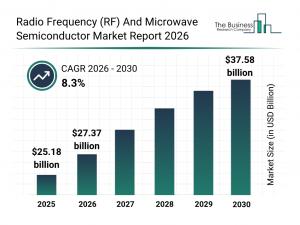
The sector has already posted notable gains, climbing from $25.18 billion in 2025 to a projected $27.37 billion in 2026 — a compound annual growth rate (CAGR) of 8.7%. Analysts attribute this recent surge to the rapid expansion of wireless communication infrastructure, greater deployment of radar systems, growth in satellite communication networks, rising demand for high-frequency automotive electronics, and increased use of RF semiconductor components in defense applications. These forces are not isolated; they are converging as industries from telecom to aerospace push the limits of what semiconductor technology can handle.
Also worth a look: Rotorcraft turboshaft engine market to hit $6.28B by 2030 as defense spending surges and Propylene carbonate market on track for $0.96B by 2030 as EV battery demand surges.
Download a free sample of the radio frequency (rf) and microwave semiconductor market report:
https://www.thebusinessresearchcompany.com/sample_request?id=90262731&type=smp&name=Radio%20Frequency%20%28RF%29%20And%20Microwave%20Semiconductor%20Market%20Report%202026&utm_source=EINPresswire&utm_medium=Paid&utm_campaign=Nov_PR
Looking further out, the market is projected to reach $37.58 billion by 2030, growing at a CAGR of 8.3%. That sustained momentum stems from several key drivers: accelerated deployment of 5G and 6G networks, rising demand for advanced aerospace and defense radar technologies, increased use of millimeter-wave sensing in automotive applications, expansion of satellite communication services, and higher adoption of gallium nitride (GaN) and silicon carbide (SiC) semiconductor technologies. Emerging trends include the development of high-frequency semiconductors purpose-built for next-generation wireless standards, widespread adoption of GaN-based RF power devices, integration of advanced radar semiconductor systems, deployment of high-frequency satellite communication components, and continuous improvements in millimeter-wave semiconductor solutions.
Understanding Radio Frequency and Microwave Semiconductors
At their core, RF and microwave semiconductors are highly specialized components designed to generate, amplify, transmit, receive, and process electrical signals within radio and microwave frequency ranges. Without them, modern high-speed wireless communications, radar operations, satellite transmissions, aerospace and defense systems, automotive electronics, and countless industrial applications would simply not function. They are the silent workhorses behind the connectivity and sensing technologies that define the current era.
View the full radio frequency (rf) and microwave semiconductor market report:
https://www.thebusinessresearchcompany.com/report/radio-frequency-rf-and-microwave-semiconductor-market-report?utm_source=EINPresswire&utm_medium=Paid&utm_campaign=Nov_PR
Primary Factors Fueling Growth in the RF and Microwave Semiconductor Market
Perhaps the single most powerful engine driving this market forward is the global rollout of 5G infrastructure. Telecom operators are investing heavily in network upgrades — installing base stations, antennas, small cells, and core network equipment — all to deliver faster data speeds and lower latency. As these networks expand, the need for RF and microwave semiconductors intensifies, since these components handle the transmission, amplification, switching, and processing of high-frequency signals inside 5G base stations and related equipment. A concrete example: in December 2025, 5G Americas reported that as of November 2025, there were 379 commercial 5G networks worldwide, including 17 in North America. Every one of those networks depends on RF and microwave semiconductors to function.
Asia-Pacific Leads the RF and Microwave Semiconductor Market Regionally
In 2025, Asia-Pacific was both the largest regional market for RF and microwave semiconductors and the region expected to grow the fastest during the forecast period. The analysis spans multiple geographic areas — Asia-Pacific, South East Asia, Western Europe, Eastern Europe, North America, South America, the Middle East, and Africa — offering a truly global view of how this market is evolving across different regulatory and economic environments.
New additions to our 2026 reports:
• Market attractiveness scoring and analysis
• Total addressable market (TAM) analysis
• Company scoring matrix graphics and tables
• Excel-based forecasting dashboards
• Market hotspots infographics
• Key technologies and future trend analysis
• Updated graphics and tables
Speak With Our Expert:
Saumya Sahay
Americas +1 310-496-7795
Asia +44 7882 955267 & +91 8897263534
Europe +44 7882 955267
Email: marketing@tbrc.info
The Business Research Company – www.thebusinessresearchcompany.com
Follow Us On:
• LinkedIn: https://in.linkedin.com/company/the-business-research-company
Oliver Guirdham
The Business Research Company
+44 7882 955267
info@tbrc.info
Visit us on social media:
LinkedIn
Facebook
X
Why it matters: The RF and microwave semiconductor market is not merely a niche segment — it is the backbone of the next wave of connectivity, from 5G and 6G networks to advanced defense radar and autonomous vehicle sensors. As billions of devices come online and demand for instantaneous, high-bandwidth communication grows, these specialized semiconductors will determine how quickly and reliably that future arrives. Investors, technology leaders, and policymakers alike should watch this space closely, because the infrastructure of tomorrow depends on the chips being designed and deployed today.