With global airlines ordering more planes and airspace growing ever more crowded, the market for the systems that keep commercial flights moving safely is climbing toward a new milestone. A fresh industry analysis reveals that spending on commercial air traffic management is projected to break the $11 billion barrier within the next decade, driven by record aircraft deliveries and mounting pressure to ease airport congestion.
The Business Research Company's Commercial Air Traffic Management Market Report 2026 – Market Size, Trends, And Global Forecast 2026-2035
The commercial air traffic management sector plays a critical role in ensuring safe and efficient operations across the aviation industry. With increasing air traffic volumes and evolving technologies, this market is experiencing notable growth. Let’s explore the current market size, key growth drivers, regional dynamics, and future trends shaping the commercial air traffic management landscape.
Also worth a look: LXHTR tackles industrial heat loss with custom seals and modular covers for heavy industry and Leomhann Enterprises founder says developing people, not sales, drove 10-year Cleveland run.
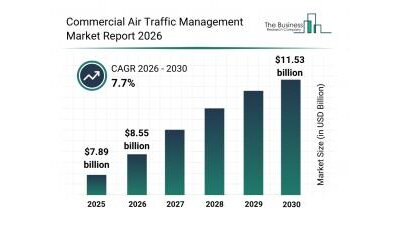
The market has already demonstrated steady momentum. According to the latest data, the industry expanded from $7.89 billion in 2025 to an expected $8.55 billion in 2026, reflecting a compound annual growth rate (CAGR) of 8.4%. Analysts attribute this historical run-up to rising commercial air traffic volumes, the urgent need to optimize airspace capacity, worsening airport congestion, wider adoption of advanced air traffic control technologies, and tighter aviation safety regulations.
Download a free sample of the commercial air traffic management market report:
https://www.thebusinessresearchcompany.com/sample_request?id=67068939&type=smp&name=Commercial%20Air%20Traffic%20Management%20Market%20Report%202026&utm_source=EINPresswire&utm_medium=Paid&utm_campaign=Nov_PR
Looking further ahead, the report forecasts that the market will sustain its robust growth trajectory, reaching $11.53 billion by 2030 at a CAGR of 7.7%. Several factors underpin this outlook: continued expansion of global passenger and cargo aviation, heightened demand for reducing flight delays, the rollout of next-generation air traffic management infrastructure, and a growing emphasis on maximizing airspace utilization. Rising investments in modern communication and surveillance systems for aviation are also expected to fuel further development. Key trends anticipated over this period include real-time air traffic flow management, advanced surveillance technologies, trajectory-based traffic control, collaborative decision-making processes, and dynamic airspace capacity adjustments.
For context, commercial air traffic management involves the systematic planning, coordination, and control of air traffic operations specifically for commercial aviation. Its purpose is to ensure the safe, efficient, and orderly movement of aircraft throughout all stages of flight. This field encompasses the comprehensive range of systems, procedures, and technologies employed by air navigation service providers, airports, and airlines to optimize airspace use, manage the flow of flights, minimize delays, and ensure compliance with stringent aviation safety standards.
View the full commercial air traffic management market report:
https://www.thebusinessresearchcompany.com/report/commercial-air-traffic-management-market-report?utm_source=EINPresswire&utm_medium=Paid&utm_campaign=Nov_PR
One of the most powerful engines behind this market expansion is the accelerating production of commercial aircraft. This process—designing, manufacturing, assembling, testing, and delivering passenger and cargo planes to airlines, leasing companies, and freight operators—is directly tied to air traffic management needs. As global air passenger traffic rises, airlines are expanding fleets, placing larger aircraft orders, and retiring older models to keep up with demand. The result is a larger worldwide fleet, more frequent flights, and increasingly congested airspace, all of which demand more sophisticated management systems to maintain safe and efficient operations. A telling example comes from Airbus SE, the Netherlands-based aerospace giant, which reported delivering 793 commercial aircraft to 91 customers worldwide in 2025—an increase of 3.5% from 766 deliveries in 2024. That single data point illustrates how growth in aircraft production directly fuels demand for advanced air traffic management solutions.
Geographically, North America commanded the largest share of the global commercial air traffic management market in 2025. However, the Asia-Pacific region is expected to post the fastest growth rates throughout the forecast period. The report covers a wide range of geographic areas, including Asia-Pacific, South East Asia, Western Europe, Eastern Europe, North America, South America, the Middle East, and Africa, providing a comprehensive view of global market trends and regional opportunities.
New additions to our 2026 reports:
• Market attractiveness scoring and analysis
• Total addressable market (TAM) analysis
• Company scoring matrix graphics and tables
• Excel-based forecasting dashboards
• Market hotspots infographics
• Key technologies and future trend analysis
• Updated graphics and tables
Speak With Our Expert:
Saumya Sahay
Americas +1 310-496-7795
Asia +44 7882 955267 & +91 8897263534
Europe +44 7882 955267
Email: marketing@tbrc.info
The Business Research Company – www.thebusinessresearchcompany.com
Follow Us On:
• LinkedIn: https://in.linkedin.com/company/the-business-research-company
Oliver Guirdham
The Business Research Company
+44 7882 955267
info@tbrc.info
Visit us on social media:
LinkedIn
Facebook
X
Why it matters: As aircraft deliveries climb and airspace becomes more congested, the systems that keep commercial aviation safe are becoming a multi-billion-dollar priority. The projected growth signals that airlines, airports, and governments will need to invest heavily in modern traffic management infrastructure to avoid gridlock in the skies. For industry stakeholders, this market trajectory underscores a widening opportunity in technologies that improve efficiency, reduce delays, and enhance safety.