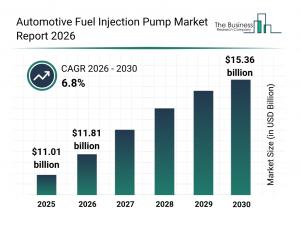
For anyone tracking the pulse of the automotive supply chain, the fuel injection pump segment is delivering a clear signal: steady, long-term growth is here. While the industry navigates the shift toward electrification, internal combustion engines aren’t going away quietly — especially in commercial fleets and emerging markets — which is precisely why the global market for these precision components is projected to climb to $15.36 billion by the end of the decade.

The Business Research Company’s Automotive Fuel Injection Pump Global Market Report 2026 – Market Size, Trends, And Forecast 2026-2035
The automotive fuel injection pump market has already shown notable expansion recently. That growth reflects increasing demand driven by evolving vehicle technologies and stricter emissions standards worldwide. As the automotive industry continues to develop, this market is set to experience sustained momentum, supported by continuous improvements in fuel injection systems and rising production volumes across major manufacturing regions.
Also worth a look: Oasis Engineering open-sources AI blueprint tool that turns HTML into construction drawings and ARIID Group brings its three-in-one design, build, furnish model to Dallas’s luxury enclaves.
Market Size and Growth Outlook
The market demonstrated strong recent performance. It is projected to increase from $11.01 billion in 2025 to $11.81 billion in 2026, representing a compound annual growth rate (CAGR) of 7.2%. That historical upward trend is largely the result of growing production of internal combustion engine (ICE) vehicles, wider adoption of common rail injection systems, rising demand for fuel-efficient engines, tighter vehicle emission regulations, and expansion of diesel-powered commercial vehicles. Looking further ahead, the market is expected to maintain solid momentum, reaching $15.36 billion by 2030 at a CAGR of 6.8%.
Download a free sample of the automotive fuel injection pump market report:
https://www.thebusinessresearchcompany.com/sample_request?id=16517169&type=smp&name=Automotive%20Fuel%20Injection%20Pump%20Market%20Report%202026&utm_source=EINPresswire&utm_medium=Paid&utm_campaign=Nov_PR
The forecasted growth is being driven by a rising demand for high-pressure fuel injection systems, continued use of ICE technology in commercial vehicles, increasing adoption of advanced direct fuel injection technologies, growing focus on precision fuel delivery, and a booming aftermarket replacement and maintenance sector. Key trends shaping the market include advanced common rail systems, ultra-high-pressure fuel injection pumps, more compact and lightweight pump designs, improved fuel pressure regulation, and the development of low-emission fuel delivery solutions.
Understanding the Role of Automotive Fuel Injection Pumps
An automotive fuel injection pump is a highly precise component designed to generate and control the fuel pressure necessary for delivering a regulated amount of fuel into an internal combustion engine’s injection system. It ensures consistent fuel flow and accurate pressure management across varying engine conditions — a function that is critical for reliable engine operation, fuel efficiency, and meeting emission standards.
View the full automotive fuel injection pump market report:
https://www.thebusinessresearchcompany.com/report/automotive-fuel-injection-pump-market-report?utm_source=EINPresswire&utm_medium=Paid&utm_campaign=Nov_PR
Primary Drivers Behind the Growth
One of the main factors propelling market expansion is the increasing production of both passenger and commercial vehicles. These vehicles serve various transportation needs, from personal use to public and commercial applications. The recovery of global supply chains after disruptions caused by the pandemic has allowed automakers to ramp up production and fulfill delayed demand from consumers and businesses alike. This surge in manufacturing naturally raises the need for fuel injection pumps, as every vehicle requires a finely tuned fuel delivery system to optimize engine performance and comply with emission regulations.
Illustrating this trend, in July 2026, Nissan Motor Co., Ltd., a Japan-based automotive manufacturer, reported that passenger vehicle production for the period April to July 2026 reached 174,977 units. This marked a 5.1% increase compared to 166,414 units during the same timeframe in 2025. Such growth in vehicle production highlights the rising demand for fuel injection pumps across the industry.
Regional Leadership and Market Expansion Prospects
In 2025, North America held the largest share of the automotive fuel injection pump market. However, the Asia-Pacific region is forecasted to experience the fastest growth throughout the upcoming years. The market report covers key geographic areas including Asia-Pacific, South East Asia, Western Europe, Eastern Europe, North America, South America, the Middle East, and Africa, providing a comprehensive view of regional trends and opportunities.
Key enhancements in our 2026 market reports include:
• Market attractiveness scoring and analysis
• Total addressable market (TAM) analysis
• Company scoring matrix graphics and tables
• Excel-based forecasting dashboards
• Market hotspots infographics
• Key technologies and future trend analysis
• Updated graphics and tables
Speak With Our Expert:
Saumya Sahay
Americas +1 310-496-7795
Asia +44 7882 955267 & +91 8897263534
Europe +44 7882 955267
Email: marketing@tbrc.info
The Business Research Company – www.thebusinessresearchcompany.com
Follow Us On:
• LinkedIn: https://in.linkedin.com/company/the-business-research-company
Oliver Guirdham
The Business Research Company
+44 7882 955267
info@tbrc.info
Visit us on social media:
LinkedIn
Facebook
X
Why it matters: Even as battery-electric vehicles grab headlines, the internal combustion engine remains the backbone of global transportation — especially in commercial fleets and developing markets. The sustained growth of the fuel injection pump market underscores that ICE technology will continue to demand innovation and investment for years to come, making it a critical sub-sector for suppliers, automakers, and investors to watch closely.