The human-computer interaction (HCI) market is no longer a niche technology segment—it’s becoming a cornerstone of the global digital economy. With projections showing the sector will exceed $1.84 trillion by 2030, businesses and investors alike need to understand where this growth is coming from and who is leading the charge.
The Business Research Company’s latest analysis, titled Human-Computer Interaction Global Market Report 2026 – Market Size, Trends, And Forecast 2026-2035, provides a comprehensive look at this rapidly expanding industry.

LONDON, GREATER LONDON, UNITED KINGDOM, October 26, 2026 /EINPresswire.com/ — The human-computer interaction (HCI) market is transforming at a remarkable pace as digital interfaces become increasingly embedded in daily routines and professional environments. The growing appetite for intuitive, immersive, and responsive technology is driving significant expansion across multiple industries.
Also worth a look: Data provenance market to hit $6B by 2030 as governance demands surge and Industrial robotics market headed past $99 billion by 2030, with China leading the pack.
According to the report, the HCI market is on track to surpass $1,840 billion by 2030—a figure that represents nearly 13% of the entire Information Technology sector, which is projected to reach $13,788 billion in the same timeframe. This outsized share underscores just how central human-machine interfaces have become to the broader tech ecosystem.
Request A Free Sample Of The Human-Computer Interaction Market Report
https://thebusinessresearchcompany.com/sample_request?id=69090525&type=smp&name=Human-Computer%20Interaction%20Market%20Report%202026&utm_source=EINPresswire&utm_medium=Paid&utm_campaign=Oct_PR
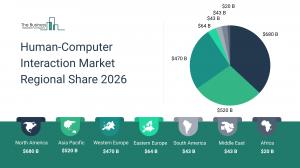
North America is expected to hold the largest regional share of the HCI market in 2030, with a projected valuation of $680 billion. The region’s market is forecast to climb from $351 billion in 2025, representing a compound annual growth rate (CAGR) of 14%. This momentum stems from widespread deployment of advanced interface technologies including augmented reality (AR), virtual reality (VR), voice recognition, and gesture-based systems. The proliferation of smart devices and connected ecosystems—combined with heavy investment in AI-driven user experience solutions across healthcare, automotive, education, and enterprise sectors in both the USA and Canada—are fueling this regional dominance.
The United States stands out as the largest single-country market within HCI, expected to reach $602 billion by 2030. That represents growth from $311 billion in 2025 at a CAGR of 14%. America’s leadership position is bolstered by a strong emphasis on human-centered design, rising demand for frictionless digital experiences, expanding wearable technology adoption, and advances in natural language processing. Investments targeting accessibility and usability innovations in interface design are also contributing significantly to the country’s market leadership.
Access The Detailed Human-Computer Interaction Market Report Here
https://thebusinessresearchcompany.com/report/human-computer-interaction-global-market-report?utm_source=EINPresswire&utm_medium=Paid&utm_campaign=Oct_PR
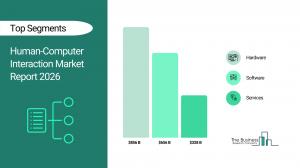
Breaking down the market by component, hardware is projected to be the largest segment, capturing 47% of the total—equivalent to $856 billion in 2030. This category benefits from escalating demand for advanced input and output devices, sensor technologies, wearable interaction tools, smart displays, and interactive systems. Innovations in haptic feedback, motion detection, and the growing array of connected consumer electronics and automotive interfaces are reinforcing this segment’s supremacy, enabling more intuitive and engaging user interactions.
The technological landscape of the HCI market is remarkably diverse, encompassing peripherals, touch screen graphical user interfaces, gesture and body recognition, speech and voice recognition, natural language processing (NLP), brain-computer interfaces, eye tracking, semiotic solutions, and other emerging technologies. This breadth illustrates the many ways humans now interact with digital environments.
Market participants range from small and medium enterprises to large corporations. In terms of application, HCI technologies are deployed across healthcare, gaming and entertainment, smart home devices and white goods, wearables, education, automotive, industrial and factory automation, commercial businesses, and numerous other fields—demonstrating extensive cross-sector adoption.
The HCI market is expected to maintain a steady CAGR of 14% through 2030, propelled by technological breakthroughs and growing demand for smarter, more accessible interaction systems.
A primary growth engine is the rising consumer and enterprise preference for user-friendly, intuitive digital interfaces. Touchscreens, voice assistants, gesture recognition, and AI-powered interaction tools are increasingly sought after for delivering seamless and personalized digital experiences. This trend is improving accessibility, operational efficiency, and customer satisfaction across healthcare, automotive, education, retail, and consumer electronics. Collectively, this demand is projected to contribute approximately 2.7% in annual growth.
The integration of artificial intelligence, augmented reality, virtual reality, and other smart interaction technologies represents another critical growth driver. These technologies enable more immersive, adaptive, and personalized user experiences while enhancing real-time interaction and automation. Their rising adoption in consumer electronics, healthcare, automotive, gaming, and enterprise sectors is accelerating demand for cutting-edge HCI solutions, with an expected contribution of roughly 2.5% in annual growth.
The growing use of connected smart devices and the push for industrial automation are further accelerating the market. The expansion of IoT, wearable tech, smart manufacturing, robotics, and Industry 4.0 systems is creating demand for advanced HCI technologies that improve operational control, monitoring, and human-machine interfacing in both consumer and industrial settings. This factor is forecast to add around 2.0% in annual market growth.
Significant growth opportunities exist across the hardware, software, and services segments of the HCI market. Together, these areas are expected to generate more than $903 billion in market value by 2030. Growth will be driven by increasing demand for immersive computing, advanced user interface frameworks, multimodal interaction capabilities, assistive technologies, and investments aimed at enhancing user engagement and digital accessibility. This trend highlights a broader push toward seamless human-system interactions in the evolving technology landscape.
Between 2025 and 2030, the hardware market is expected to expand by $418 billion, the software segment by $330 billion, and the services segment by $155 billion. This growth reflects ongoing innovation and adoption within immersive and interactive computing environments.
The competitive landscape features a blend of global tech giants and specialized solution providers. These companies focus on artificial intelligence, voice and gesture recognition, immersive technologies, and personalized digital platforms to enhance user experience. Prioritizing intuitive design, accessibility, real-time interaction, and digital integration remains essential for maintaining competitive advantage and fostering innovation in this rapidly evolving field.
In 2025, Apple Inc. topped the global HCI market with a 3% share. The company’s technology products and services division drives this leadership by offering a wide range of devices, operating systems, user interface technologies, and intelligent interaction solutions that support connected ecosystems and advanced computing applications.
Key players in the HCI industry include Apple Inc, Microsoft Corporation, Alphabet Inc. (Google LLC), Amazon Web Services, Inc., NVIDIA Corporation, Meta Platforms Inc, International Business Machines Corporation, Panasonic Corporation, Intel Corporation, Sony Group Corporation, Texas Instruments Incorporated, Dell Technologies Inc, Microchip Technology Inc, Infineon Technologies AG, Tencent Holdings Ltd, LG Electronics Inc, GestureTek, HaptX Inc, Cogniac Corporation, Ommo Technologies Pvt Ltd, and TANGI0 LTD.
The HCI market is relatively fragmented, with the top 10 players holding approximately 9% of total revenue in 2025. This reflects moderate barriers to entry influenced by rapid innovation cycles, evolving interface requirements, software development complexity, and the need to deliver reliable, seamless interaction experiences. Leading companies maintain their positions through diverse product portfolios, established ecosystems, extensive distribution, and ongoing technological advancements. As demand for advanced AI, immersive interfaces, and intelligent devices grows, strategic partnerships and innovation will be crucial for these market leaders.
Among the top companies, Apple Inc commands a 3% market share, followed by Microsoft Corporation and Alphabet Inc. (Google LLC) each at 2%, and smaller shares held by Amazon Web Services, Inc. (0.4%), NVIDIA Corporation (0.4%), Meta Platforms Inc (0.2%), International Business Machines Corporation (0.2%), Panasonic Corporation (0.2%), Intel Corporation (0.2%), and Sony Group Corporation (0.2%).
Important raw material suppliers supporting the HCI market include NVIDIA Corporation, Intel Corporation, Advanced Micro Devices Inc. (AMD), Qualcomm Incorporated, Texas Instruments Incorporated, STMicroelectronics N.V., NXP Semiconductors N.V., Analog Devices Inc., Microchip Technology Incorporated, Sony Semiconductor Solutions Corporation, Samsung Display Co. Ltd., LG Display Co. Ltd., BOE Technology Group Co. Ltd., Corning Incorporated, TDK Corporation, Murata Manufacturing Co. Ltd., Bosch Sensortec GmbH, Infineon Technologies AG, Renesas Electronics Corporation, OmniVision Technologies Inc., Synaptics Incorporated, Cirrus Logic Inc., Goertek Inc., AAC Technologies Holdings Inc., and Knowles Corporation.
Major distributors and wholesalers include Ingram Micro Inc., TD SYNNEX Corporation, Arrow Electronics Inc., Avnet Inc., DigiKey Electronics, Mouser Electronics Inc., Future Electronics Inc., RS Group plc, Newark Electronics, Farnell, Allied Electronics & Automation, CDW Corporation, Insight Enterprises Inc., SHI International Corp., Computacenter plc, Bechtle AG, ALSO Holding AG, Westcon Group, Exclusive Networks SA, Redington Limited, Mindware FZ LLC, ASBIS Enterprises PLC, EET Group A/S, Macnica Holdings Inc., and WT Microelectronics Co. Ltd.
Key end users span a wide range of industries and companies, including Apple Inc., Microsoft Corporation, Alphabet Inc., Meta Platforms Inc., Amazon.com Inc., Samsung Electronics Co. Ltd., Sony Group Corporation, Tesla Inc., BMW AG, Mercedes-Benz Group AG, Toyota Motor Corporation, Ford Motor Company, Siemens Healthineers AG, Philips Healthcare, GE HealthCare Technologies Inc., Mayo Clinic, Cleveland Clinic, JPMorgan Chase & Co., Bank of America Corporation, Walmart Inc., The Walt Disney Company, Netflix Inc., Boeing Company, Airbus SE, and Accenture plc.
Augmented reality (AR) glasses are revolutionizing HCI by offering hands-free computing and immersive digital experiences, enabling more natural interaction modes. For example, in June 2026, Snap Inc. unveiled SPECS, a next-generation AR glasses product featuring AI assistance and spatial computing. Its cutting-edge display and waveguide technologies support contextual interaction and screen-free computing, enhancing user engagement.
To maintain an edge, companies are focusing on advancing AI-powered interface technologies for intelligent and personalized interactions. They are also leveraging AR and VR innovations to improve engagement and digital experiences, expanding HCI systems and devices to boost accessibility and productivity, and integrating multimodal technologies to enhance accuracy and efficiency.
This comprehensive overview reveals the dynamic and fast-growing human-computer interaction market, driven by continual technological innovations and increasing demand for smarter, more intuitive digital interfaces across various industries.
Expanded capabilities in the 2026 market reports include market attractiveness scoring and analysis, total addressable market (TAM) analysis, company scoring matrix graphics and tables, Excel-based forecasting dashboards, market hotspots infographics, key technologies and future trend analysis, and updated graphics and tables.
Learn More About The Business Research Company
The Business Research Company (www.thebusinessresearchcompany.com) is a leading market intelligence firm renowned for its expertise in company, market, and consumer research. The firm has published over 30,000+ reports across 27 industries and 60+ geographies, powered by 1,500,000 datasets, extensive secondary research, and exclusive insights from interviews with industry leaders.
The company provides continuous and custom research services, offering specialized packages including Market Entry Research Package, Competitor Tracking Package, Supplier & Distributor Package, and more.
Disclaimer: Please note that the findings, conclusions and recommendations that TBRC Business Research Pvt Ltd delivers are based on information gathered in good faith from both primary and secondary sources, whose accuracy they are not always in a position to guarantee. As such TBRC Business Research Pvt Ltd can accept no liability whatever for actions taken based on any information that may subsequently prove to be incorrect. Analysis and findings included in TBRC reports and presentations are estimates, opinions and are not intended as statements of fact or investment guidance.
Contact Us:
The Business Research Company
Americas +1 310-496-7795
Europe +44 7882 955267
Asia & Others +44 7882 955267 & +91 8897263534
Email: marketing@tbrc.info
Follow Us On:
LinkedIn: https://in.linkedin.com/company/the-business-research-company.
Oliver Guirdham
The Business Research Company
+44 7882 955267
info@tbrc.info
Visit us on social media:
LinkedIn
Facebook
X
Why it matters: As HCI becomes a nearly $2 trillion market representing 13% of all IT spending, companies that fail to invest in intuitive interface technologies risk losing ground to competitors who prioritize user experience. The fragmented competitive landscape—where even the market leader holds just 3%—signals that significant opportunities remain for both established players and emerging innovators.