For engineers, procurement specialists, and automation professionals, understanding how a solenoid valve is actually built — from copper wire selection to final leak testing — can be the difference between a system that runs for a million cycles and one that fails on the shop floor. That is the gap Weilong Technology, a Guangdong-based manufacturer with two decades in electromagnetic control, aims to close with its new comprehensive production guide.
DONGGUAN, GUANGDONG, CHINA, October 25, 2026 /EINPresswire.com/ — Solenoids and solenoid valves are foundational components in automation, fluid control systems, industrial equipment, automotive applications, medical devices, and home appliances. These compact devices carry significant functional weight, converting electrical energy into mechanical motion and regulating the flow of liquids and gases.
A solenoid uses electromagnetic force to generate linear motion. When paired with a valve mechanism, this electromagnet actuator opens, closes, or redirects fluid flow. Solenoid valves have become a standard automatic control element in industry because of their fast response, precise control, and reliability.
But how are these components actually produced? What materials go into them, and what stages does the manufacturing process involve? This guide walks through the entire journey, from initial design to final quality inspection.
1. What is a solenoid?
A solenoid is an electromagnetic device that transforms electrical energy into mechanical energy. Its core design elements include a copper coil, a magnetic core, a moving plunger, a spring mechanism, a protective housing, and electrical terminals. When current passes through the coil, the resulting magnetic field moves the plunger, producing linear motion.
This motion is used for opening and shutting valves, locking mechanisms, switching devices, mechanical actuators, and industrial automation equipment. A high-quality solenoid valve must deliver powerful electromagnetic force, fast response times, low power consumption, high durability, and robust performance across varying conditions.
2. What is a solenoid valve?
A solenoid valve is an automatic valve controlled by an electromagnetic solenoid. It regulates the flow of water, air, gas, oil, vapor, and other industrial fluids. Electrical signals drive the valve: when power is applied, the solenoid generates a magnetic force that moves the internal plunger, opening or closing the valve passage.
Compared with traditional manually-operated valves, solenoid valves offer automatic operation, remote control capability, fast switching speeds, precise flow control, and reduced staffing requirements. Typical applications span industrial automation systems, air tools, irrigation systems, heating and cooling equipment, water treatment devices, medical instruments, and automotive systems.
3. The solenoid design
Before production begins, an engineer must determine what type of solenoid is needed.
3.1 Defining operational requirements
The operating environment dictates the design. Key considerations include voltage — with common options being 6 V DC, 12 V DC, 24 V DC, 110 V AC, and 220 V AC — since the correct voltage ensures stable operation and prevents overheating. Force requirements are equally critical; the electromagnetic force must match the mechanical load, and higher force typically requires more coil turns and better magnetic materials. Stroke range — the distance the plunger travels — also matters. Short strokes suit mini valves, locks, and precision instruments, while long strokes are reserved for industrial plants and heavy-duty applications.
4. The manufacture of the solenoid coils
The coil is the heart of any solenoid.
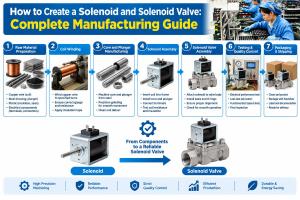
Step 1: Choosing a copper wire
Most solenoid coils are wound with enamelled copper wire, chosen for its excellent electrical conductivity, heat resistance, and long service life. Wire diameter and insulation thickness are selected based on current, operating temperature, and required magnetic force.
Step 2: Winding a coil
Precision winding equipment wraps the copper wire onto a bobbin. Winding parameters — including the number of turns, wire configuration, and coil resistance — determine the electrical characteristics. A well-wound coil ensures a stable magnetic field, efficient energy conversion, and reliable operation.
Step 3: Coil protection
After winding, coils receive insulation treatment, resin sealing, and protective coatings. These measures boost resistance to moisture, dust, temperature fluctuations, and mechanical vibration.
5. Production of solenoid components
Several precision parts are essential to a finished solenoid.
Plunger and magnetic core
Cores and plungers are typically made from magnetic materials such as low-carbon steel, which offers high magnetic permeability, fast response, and minimal losses. Plunger finishing is critical because it affects friction, movement accuracy, and lifecycle.
The spring fabrication
The return stroke of the plunger depends on a spring. Proper spring design delivers the correct returning force, accurate operation, and a long service life.
Production of the housing
The housing shields internal components. Common materials include steel, stainless steel, brass, aluminum, and engineering plastics. The choice depends on pressure requirements, the chemical environment, and temperature demands.
6. The manufacture of the solenoid valve
A solenoid valve combines an electromagnetic actuator with a valve body.
Step 1: Designing the valve body
Engineers design the valve body around the fluid type, operating pressure, flow rate, connection size, and temperature range. Two common designs exist. Direct-acting solenoid valves use the plunger to open or shut the valve, offering fast response, simple design, and operation without a pressure differential — ideal for small water systems, medical devices, and laboratory equipment. Pilot-operated solenoid valves rely on fluid pressure assistance, providing higher flow capacity for large pipes and energy savings, making them suitable for industrial systems, HVAC equipment, and water management.
7. The assembly procedure of the solenoid valve
Once components are manufactured, assembly begins. Technicians install the internal parts — plunger, seal spring, diaphragm, and valve core — with precision to ensure accurate movement and sealing. The electromagnetic coil is then fitted to the valve body, requiring proper positioning, good electrical contact, and safety. Final adjustments verify normal opening pressure, perfect closing performance, and consistent switching rates.
8. Quality checking for the solenoid valves
Quality control is non-negotiable in solenoid valve production. Professional manufacturers run several checks. Electrical checks verify coil resistance, insulation performance, voltage compatibility, and power consumption. Leak checkups use pressure testing to confirm there is no leakage and that sealing is sound. Flow tests measure flow rate, pressure drop, and response time. Life cycle tests subject valves to thousands of switching cycles, temperature extremes, and vibration to confirm durability.
9. Applications of solenoids and solenoid valves
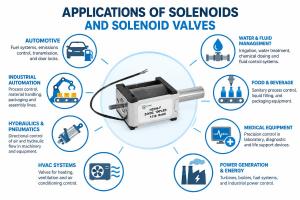
These components are ubiquitous. In industrial automation, they handle pneumatic control, production equipment, robotic systems, and assembly machines. In automotive systems, they manage fuel systems, transmission control, and emission systems. Water control applications include irrigation systems, water coolers, pumps, and filtration equipment. Medical supplies rely on them for oxygen systems, diagnostic devices, and lab instruments.
About Weilong: Professional solenoid valve manufacturer
Weilong Technology brings 20 years of experience in electromagnetic control technologies, focusing on research, development, and manufacturing of high-quality solenoid valves and products for customers worldwide. The company serves the automation industry, water treatment facilities, electrical appliances, medical supplies, automotive systems, and fluid control applications.
Advanced production technology, strict quality assurance, and engineering expertise allow Weilong to meet demands for high reliability, extended life cycles, consistent performance, and individual customer needs. The company controls the entire production process — from electromagnetic coil design and precision manufacturing to assembly and performance verification — ensuring consistent product quality. Weilong offers professional technical support and manufacturing capabilities for both standard and customized solenoid valves. For more information, visit the Weilong website at http://www.smartsolenoid.com or contact the sales team at weilongsolenoid@gmail.com. Phone and WhatsApp: 86 136 4298 0378.
Conclusion
Producing reliable solenoids demands experience, knowledge, manufacturing precision, and strict quality control. Every step — from coil design to assembly and performance testing — affects the final product. As automation technologies advance, solenoid valves will remain essential for managing fluid and mechanical motion across industries. Working with a qualified manufacturer like Weilong can deliver higher performance, longer service life, and greater reliability.
FAQs on solenoid and solenoid valve manufacturing
12.1 What is the difference between a solenoid and a solenoid valve?
The solenoid is the electromagnetic actuator that generates linear motion. The solenoid valve is the valve operated by that actuator.
12.2 How does the solenoid valve work?
Electrical energy creates a magnetic field in the solenoid, moving the internal plunger to open or close the valve passage.
12.3 What materials are used in solenoid valve production?
Typical materials include bronze, stainless steel, aluminum, engineering plastics, and rubber sealing materials. Selection depends on the application and fluid type.
12.4 How long does a solenoid valve operate?
With proper design, manufacturing, and maintenance, a high-quality solenoid valve can operate for millions of cycles.
12.5 Can solenoid valves be customized?
Yes. Manufacturers can tailor voltage, port size, materials, pressure ratios, connector type, and service environment.
12.6 How do you choose the right solenoid valve?
Consider fluid type, working pressure, temperature, flow requirements, voltage, and installation environment. A professional manufacturer can assist in selecting the right model.
12.7 Why choose Weilong for solenoid valve solutions?
Weilong has 20 years of experience in solenoids and solenoid valves, offering professional manufacturing with high-quality control, engineering support, and tailored solutions for various industries.
Weilong Technology
Weilong Technology
Why it matters: As global automation and fluid-control demands grow, understanding the manufacturing rigor behind these small but critical components helps buyers make informed sourcing decisions. A solenoid valve’s reliability — measured in millions of cycles — is not accidental; it is engineered through material selection, precision assembly, and relentless quality testing. For businesses, partnering with a manufacturer that controls the entire production chain can directly impact operational uptime and maintenance costs.