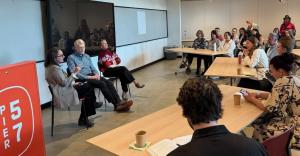
When a Climate Week NYC session on wildfire risk and community resilience draws a standing-room-only crowd, it signals more than just interest—it suggests a real hunger for actionable solutions. That was the scene at Pier 57, where Innovera, a nonprofit focused on community-beneficial infrastructure and climate resilience, convened leaders from across disciplines for an energetic, oversubscribed discussion. Now, following that momentum, the organization has announced the launch of collaborative working groups in mid-October to advance its CIRCLE framework.
The event, titled “From Wildfire Risk to Community Resilience: Financing and Delivering System-Scale Solutions,” brought together Innovera’s Gifford Pinchot III, Co-Founder and Senior Fellow, and Stephanie Glazer, Managing Director, alongside California Forward’s Chief Operating Officer Nuin-Tara Key. Together, they examined how communities can share responsibility and risk, strengthen infrastructure, and mobilize investment in the face of growing physical climate threats. The conversation also explored how innovative financing and public-private collaboration can help communities prepare for and recover from wildfires, while aligning infrastructure investments with lasting community benefits.
“The energy in the room reflected a shared goal to turn promising ideas into action,” said Pinchot. “I was especially encouraged by the next generation’s curiosity and commitment. Their ideas and leadership will be essential as we work together to steward community resilience forward.”
During the program, Glazer introduced Innovera’s CIRCLE Framework—short for Connected Infrastructure for Resilient Communities & Local Economies. This approach rethinks infrastructure investments to deliver and protect long-term community benefits. The discussion zeroed in on how legal, financial, and governance structures can better align the often-divergent interests of communities, public agencies, businesses, and investors.
“Our CIRCLE Framework starts with a practical question: How can infrastructure investments create lasting value for the communities where they are built?” explained Glazer. “This Climate Week event, along with our recent virtual sessions, has generated great ideas and new connections. With our working groups launching this month, we will bring collaborators together to build those ideas into community-beneficial structures that can help strengthen local economies and community resilience, keeping more value local.”
The newly formed working groups will build directly on these concepts, aiming to develop new approaches, partnerships, and high-potential models for community-beneficial infrastructure and climate resilience. Innovera also extended thanks to Sara Blenkhorn of the Buckminster Fuller Institute, who opened the Climate Week program, and Albana Theka, President of the Financial Women’s Association of New York, who delivered welcome remarks.
For those looking to get involved, Innovera is directing interested parties to several resources: review the CIRCLE Framework, register interest in Innovera’s working groups, or explore the Climate Week NYC event summary and photo gallery. For working group inquiries, contact Stephanie Glazer at stephanie.glazer@innovera.group.
Innovera is a nonprofit organization dedicated to accelerating climate innovation and strengthening community and organizational resilience. By convening leaders across sectors and offering programs that empower innovators, the organization advances scalable solutions for more resilient communities, sustainable infrastructure, and lasting environmental and economic value. More information is available at www.innovera.group.
Stephanie Glazer
Innovera
stephanie.glazer@innovera.group
Why it matters: As climate risks like wildfires intensify, the challenge is no longer just about technology—it’s about building the legal, financial, and governance frameworks that can turn good ideas into durable community protections. Innovera’s working groups aim to close that gap, creating models that keep economic value local while strengthening resilience. If successful, this collaborative approach could become a template for communities nationwide facing similar threats.